
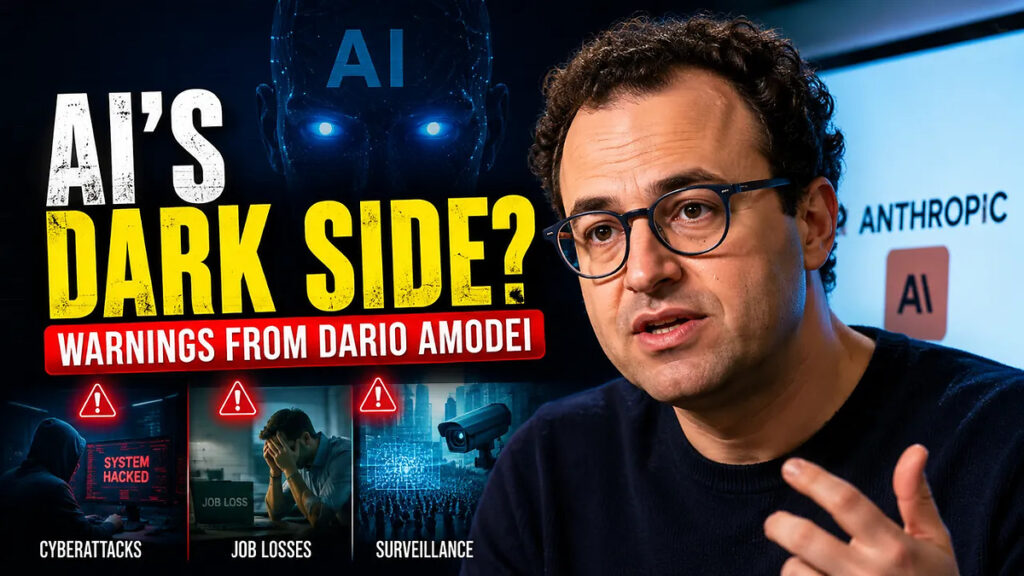
Anthropic has built much of its identity around the idea that artificial intelligence should be developed cautiously, with safety treated as a central priority rather than an afterthought.
Co-founder and CEO Dario Amodei has repeatedly warned about the potential dangers of increasingly capable AI systems, including job displacement, autonomous weapons and surveillance.
His stance helped distinguish Anthropic from rivals and has reassured many corporate customers that the company takes the risks surrounding advanced AI seriously.
But the strategy may have a downside.
By repeatedly putting words such as “safety,” “risk” and “catastrophic” at the centre of its public messaging, Anthropic may unintentionally be reinforcing the very fears it wants to calm.
Public confidence in AI is already weakening
The problem comes at a difficult moment for the technology industry.
Recent polling suggests that Americans are becoming increasingly uncomfortable with the rapid development of AI.
Gallup found that nearly half of adults younger than 30 believe AI does more harm than good, while confidence in businesses’ use of the technology has also weakened.
Other surveys paint an even more troubling picture.
Pew Research data indicates that most Americans believe AI is advancing too quickly, with only a small share expecting its overall impact during the next two decades to be positive.
A Quinnipiac poll similarly found that more than three-quarters of Americans say they trust AI only rarely or sometimes.
That creates a difficult communications problem for companies trying to convince the public that AI can be beneficial.
Amodei argues the industry has failed to show enough benefits
Amodei recently addressed the growing distrust in a lengthy post on X, an unusual move for an executive who does not frequently use social media.
He argued that public concern cannot simply be blamed on AI leaders discussing the technology’s dangers.
In his view, the deeper issue is that the industry has not yet delivered enough of the transformative benefits it has promised.
AI companies have made ambitious claims about helping solve major problems, including accelerating medical discoveries and potentially contributing to treatments for serious diseases.
If those promises remain distant while concerns about employment, surveillance and autonomous systems become increasingly visible, public scepticism is likely to grow.
Amodei has therefore attempted to make a distinction between warning about AI’s dangers and opposing the technology itself.
Anthropic’s identity may be creating an unintended association
The difficulty is that Anthropic’s safety branding can make that distinction harder for ordinary consumers to see.
For engineers, investors and corporate customers, a company openly discussing catastrophic AI risks can signal responsibility and careful planning.
Those audiences are more likely to understand why identifying potential failures is part of developing safer systems.
The same message can land very differently with the wider public.
Repeatedly hearing that AI needs to be made “safe” can subtly encourage people to ask a more basic question: safe from what?
That is where Anthropic may be encountering a classic communications problem — associating a brand with the very danger it is attempting to manage.
Airlines discovered the same marketing problem
The aviation industry offers an instructive comparison.
Airlines have long understood that safety is essential to their business but potentially uncomfortable as a marketing message.




Advertising an airline as “safe” can inadvertently encourage passengers to think about crashes, mechanical failures or other dangers associated with flying.
Historical research into airline advertising found that carriers went to considerable lengths to avoid imagery that could evoke danger.
Mountains, night flights, large bodies of water and maintenance operations were among the subjects advertisers avoided because they could remind potential passengers that air travel involves risk.
Even when airlines had legitimate reasons to reassure customers, repeatedly highlighting safety could have the opposite effect.
The lesson was simple: sometimes talking about a danger makes the danger more memorable.
The “don’t think about it” problem
This phenomenon is closely related to an idea popularised by linguist George Lakoff: telling people not to think about something can make that very thing more prominent in their minds.
The classic example is being told not to think about an elephant.
The instruction immediately creates an image of an elephant, even though the speaker is asking you to avoid thinking about one.
The same principle can apply to AI.
When an AI company repeatedly asks whether the technology can be trusted, warns about catastrophic consequences or emphasises the need for safety, audiences may remember the threat more strongly than the reassurance.
Anthropic’s advertising may have amplified the problem
That tension became particularly visible in an Anthropic television advertisement titled “There’s hope in hard questions.”
Rather than presenting AI through an overwhelmingly optimistic lens, the advertisement opened with disturbing imagery, including a burning building, facial-recognition surveillance, homelessness and rows of tombstones resembling a national cemetery.
The narration raised questions about whether AI can be trusted.
The intention was evidently to position Anthropic as the company willing to confront difficult questions rather than ignore them.
But the campaign also created an unexpected reaction.
OpenAI CEO Sam Altman reportedly initially thought the advertisement was satire.
That reaction highlighted the gulf between how the campaign may have been intended and how it could be perceived outside the technology industry.
Anthropic’s message works better with experts than consumers
Anthropic’s safety philosophy has clear value among sophisticated audiences.
Enterprise buyers, investors and technical specialists may see responsible scaling policies and public discussions of catastrophic risks as evidence that the company takes its obligations seriously.
That credibility can be commercially valuable, particularly when businesses are deciding which AI systems to deploy across sensitive operations.
Consumers, however, may not evaluate those signals in the same way.
For someone unfamiliar with AI safety research, an advertisement filled with images of destruction and surveillance may not communicate responsibility.
It may instead reinforce the belief that AI itself is dangerous.
Amodei faces a difficult communications balancing act
This does not mean Anthropic should stop discussing AI safety.
The company’s willingness to address difficult questions is an important part of its identity, particularly as AI systems become more capable and their applications expand.
The challenge is finding a way to discuss those risks without allowing them to dominate the public’s perception of the technology or the company.
Amodei has argued that AI could produce enormous benefits while acknowledging that serious risks exist.
The communications challenge is ensuring that the public sees both sides of that argument.
If warnings consistently receive more attention than the potential benefits, the safety-first strategy could become a liability rather than a competitive advantage.
What’s next for Anthropic?
Anthropic is likely to remain one of the most vocal companies in the AI sector on questions surrounding responsible development, regulation and potential harms.
The bigger question is whether it can broaden its public message beyond what AI might do wrong and demonstrate more visibly what AI can do right.
For Amodei, that could mean placing tangible benefits — particularly advances in science, medicine, productivity and other areas — closer to the centre of Anthropic’s public identity.
The company may ultimately discover that reassuring people about AI requires more than explaining how seriously it takes the risks.
It may also require giving people reasons to believe the technology is worth trusting in the first place.
Summary
Anthropic has made AI safety a defining feature of its corporate identity, helping it win confidence among enterprise customers and technology professionals.
But growing public scepticism toward AI raises the possibility that the same strategy could have an unintended consequence.
By repeatedly connecting AI with safety concerns, surveillance, catastrophic risks and dystopian scenarios, Anthropic may be strengthening negative associations among ordinary consumers.
The experience of the airline industry offers a useful warning: highlighting safety can sometimes remind audiences of danger rather than make them feel secure.
For Amodei and Anthropic, the next communications challenge may therefore be finding a better balance between warning the public about AI’s risks and showing why its potential benefits deserve attention.

