
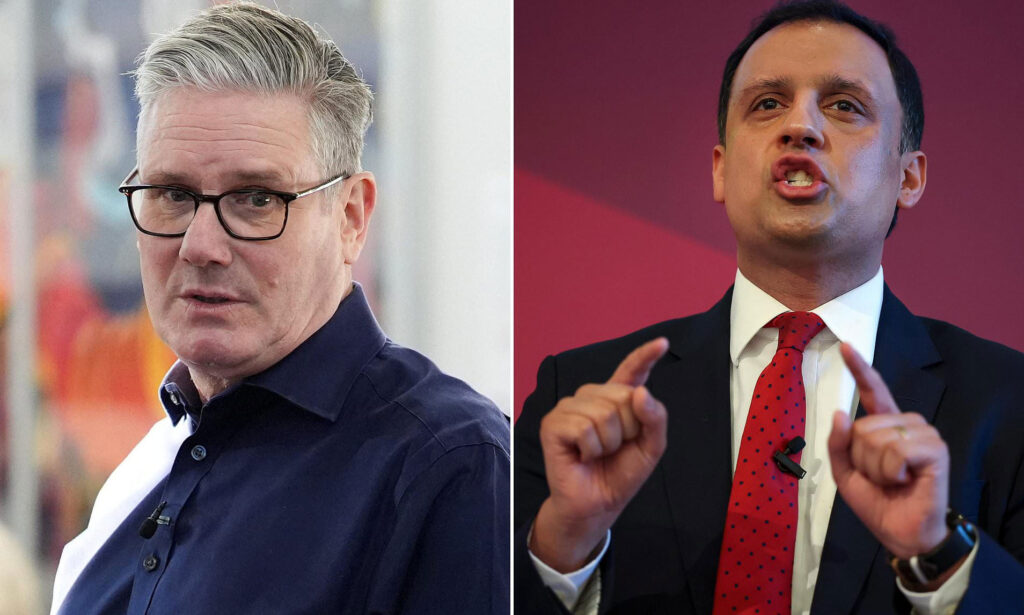
Scottish Labour leader Anas Sarwar has openly called for the Prime Minister to step down, marking one of the most high-profile internal criticisms of Sir Keir Starmer since he became Labour leader.
Sarwar cited a string of government missteps and growing dissatisfaction among voters as the reason for his bold move.
While Sarwar’s intervention hasn’t yet triggered a broader rebellion within the party, it has intensified scrutiny on Sir Keir’s leadership at Westminster.
Senior Cabinet ministers have rallied behind Starmer for now, giving him a temporary reprieve, but the internal tensions highlight the growing unease within Labour ranks.
Polling Guru Slams Starmer’s Leadership
Professor Sir John Curtice, one of the UK’s most respected political pollsters, weighed in on the controversy with a blunt assessment.
Speaking on ITV’s Peston show, he described Sir Keir as “bland, boring, uncharismatic,” and accused him of lacking both direction and vision.
Curtice argued that Sarwar’s criticism was a rational move.
“You’re looking at somebody who had come to realise he was sitting in a car that was about to crash at the end of a cul-de-sac,” he said.
According to Curtice, distancing himself from Starmer was an attempt by Sarwar to protect Scottish Labour’s reputation ahead of the Scottish Parliament elections in May.
The Voter Perspective: Unpopularity Across the Board
Curtice also pointed out that Starmer isn’t the only political figure struggling with voter confidence.




“All of our leaders are unpopular because all of our parties are unpopular,” he noted, emphasizing a broader shift in British politics.
Unlike previous eras dominated by two major parties, voters today are more fragmented and skeptical, making it harder for any leader to command strong support.
Polling and “word cloud” analyses consistently associate Starmer with terms like “bland” and “boring,” reflecting widespread uncertainty about what he stands for.
Curtice highlighted that government U-turns, including controversies such as the winter fuel allowance, have further chipped away at public confidence.
The Scottish Context: Labour Faces a ‘Car Crash’
The impact of Starmer’s Westminster unpopularity is particularly acute in Scotland, where even Labour’s traditional supporters are questioning the party’s performance.
Curtice warned that Scottish Labour could face a “car crash” unless it manages to carve out a distinct identity separate from the UK Labour Government.
“Even the people who voted Labour in Scotland in 2024 do not think the UK Labour Government is doing a good job,” Curtice said, underscoring the uphill battle facing Sarwar as he tries to steer the party through an increasingly challenging political landscape.
What’s next?
With the Scottish Parliament elections looming in May, Sarwar’s challenge may set the stage for a test of Scottish Labour’s independence from Starmer’s leadership.
Analysts suggest that if the party fails to distinguish itself, it could face heavy losses, particularly to the SNP, which has been consolidating support in recent years.
Meanwhile, Starmer will need to address criticisms of his leadership style and clarify his vision to regain voter confidence at the national level.
Summary
Anas Sarwar’s call for the Prime Minister to resign has shone a harsh light on Sir Keir Starmer’s leadership struggles.
Criticized for being “bland” and lacking charisma, Starmer faces declining popularity across the UK, with particular ramifications for Scottish Labour.
Polling expert Sir John Curtice frames Sarwar’s stance as a rational effort to distance himself from a government seen as ineffective, but both leaders now face mounting pressure as elections approach.
Scottish Labour must navigate the challenge of asserting its independence while mitigating the fallout from Westminster’s unpopularity.
