Four World War Two airmen whose graves had remained unidentified for decades have finally been commemorated by name after an 82-year investigation uncovered the circumstances surrounding their deaths.
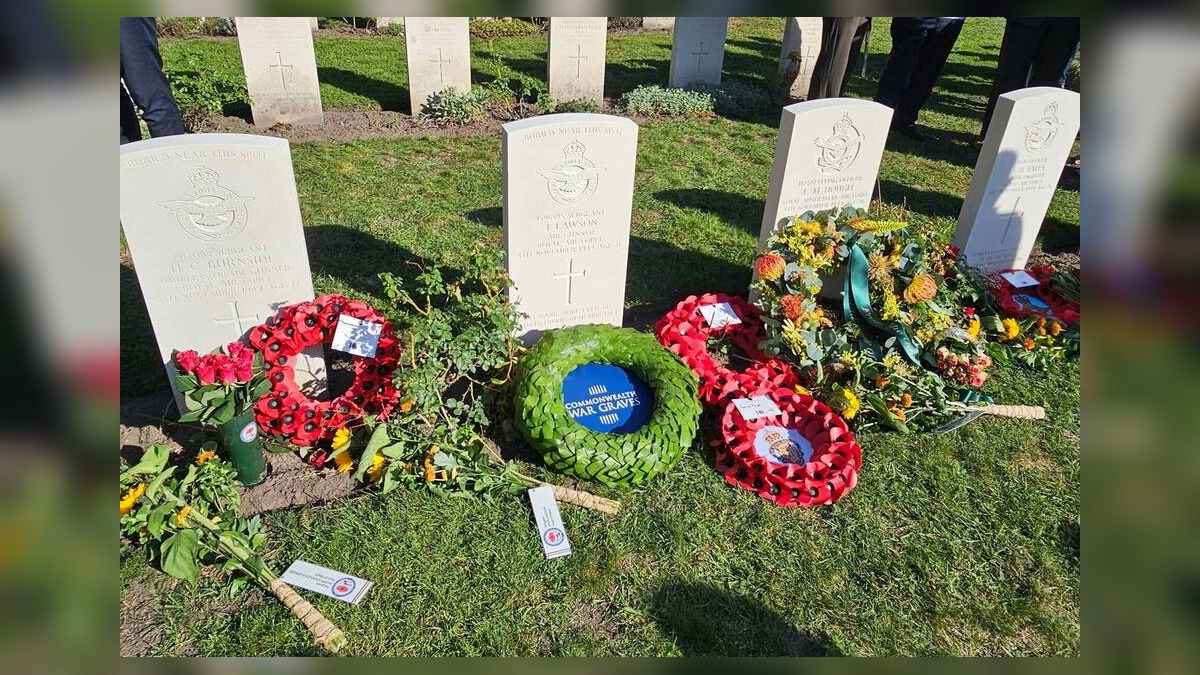
Flying Officer Leslie Markland Hough of the Royal Australian Air Force, Pilot Officer John Henry Tales of the Royal Air Force Volunteer Reserve, Sergeant Henry Charles Burnside and Sergeant John Lawson were formally honoured during a rededication service at the Commonwealth War Graves Commission’s Venray War Cemetery in the Netherlands.
Their remains had previously been buried in graves marked only as unknown, following a series of administrative errors in the aftermath of the war.
Lancaster PD374 lost over Germany
The four men were members of the seven-man crew of Lancaster PD374, operated by No. 218 Squadron RAF.
On 8 December 1944, the bomber departed RAF Methwold in Norfolk as part of a force of more than 130 aircraft assigned to attack the Neerbeck oil plant at Homberg in Germany’s Ruhr region.
Three members of the crew managed to escape by parachute and were subsequently taken prisoner.
The remaining four airmen died when the Lancaster crashed.
Their identities were eventually established through an 82-year effort to resolve the long-standing mystery surrounding the aircraft and its crew.
Families attend long-awaited ceremony
The newly identified airmen were remembered at the service alongside relatives, military representatives and members of the local community.
JCCC Caseworker Tracey Bowers said the presence of the families made the occasion particularly poignant, highlighting the significance of bringing together relatives of the crew and people who had adopted responsibility for caring for their graves.
The ceremony provided relatives with the opportunity to honour their family members at graves that now carry their correct names.
John Tales returned to operations voluntarily
Pilot Officer Tales was born in Attercliffe, Sheffield, on 31 December 1917 and was one of 11 children.


Before joining the RAF in September 1939, he worked as a poster writer.
He went on to establish a strong service record and had already completed a full operational tour before volunteering to return to frontline duties.
Tales joined No. 218 Squadron in August 1944, only months before the fatal mission involving Lancaster PD374.
His nephew, John Tales, attended the ceremony with other relatives and described the occasion as poignant, saying the family was honoured to learn more about their uncle and grateful to those who helped establish his identity.
Hough remained at the controls
The Lancaster was captained by Flying Officer Leslie Markland Hough, an Australian serving with the Royal Australian Air Force.
Eyewitness accounts indicate that Hough remained at the controls of the burning aircraft, apparently allowing other members of the crew more time to escape.
His actions formed part of the circumstances surrounding the loss of Lancaster PD374 and the deaths of the four men who were later buried without their identities being recorded correctly.
Burnside and Lawson remembered
Sergeant Henry Charles Burnside was remembered for his professionalism and immaculate appearance during his service.
Sergeant John Lawson, known affectionately as “Geordie”, came from a mining family in County Durham and was also among those who died in the Lancaster crash.
Lawson’s nephews, Thurston Lawson and John Lawson, attended the rededication ceremony.
Thurston Lawson described the day as memorable and praised the people and organisations involved in the service.
Graves rededicated under their rightful names
The rededication was conducted by Reverend Group Captain Ruth Hake, who described it as a privilege to lead the ceremony for Hough, Tales, Burnside and Lawson.
She said the four airmen had given their lives in defence of their country and that placing their names on the graves allowed them to be properly honoured alongside their loved ones.
The ceremony formally marked the graves with the identities of the four members of Lancaster PD374, replacing the decades-old designation of unknown servicemen.
CWGC confirms identities of four airmen
Dr Daniel Seaton, Commemorations Case Officer at the Commonwealth War Graves Commission, said the organisation was pleased that the final resting place of the four airmen had been identified after so many years.
He noted that numerous family members had attended the ceremony and could now visit graves bearing the names of their relatives.
The Commonwealth War Graves Commission will continue to maintain the graves at Venray War Cemetery.
