
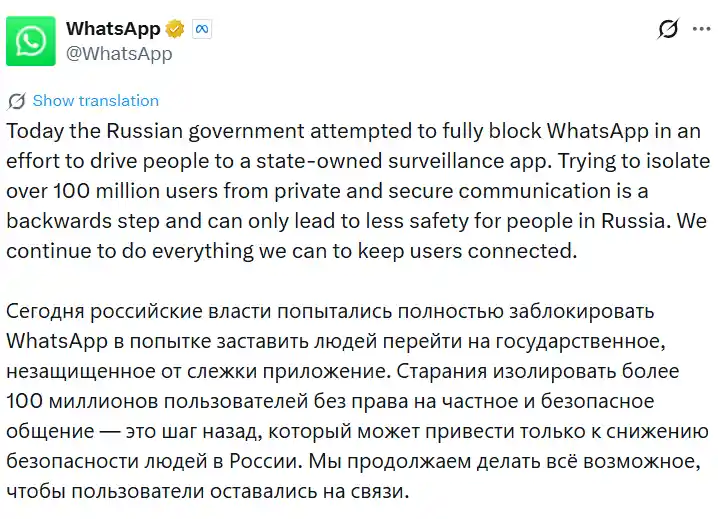
WhatsApp, the Meta-owned messaging platform, has raised the alarm over Russia’s moves to restrict access to its service, potentially affecting over 100 million users.
According to the company, the actions are designed to steer Russians toward Max, the state-backed messaging app, and undermine private, secure communication.
In a post on X, WhatsApp emphasized that “trying to isolate over 100 million users from private and secure communication is a backward step and can only lead to less safety for people in Russia.”
The company added that it is doing everything possible to ensure its users remain connected.
Russia’s Push for a Domestic Messaging Alternative
Max, the Russian government-backed app, was launched in March 2025 by VK, a prominent Russian tech firm, as a homegrown alternative to foreign-owned platforms such as WhatsApp and Telegram.
Since its release, authorities have been heavily promoting Max.
By September 1, 2025, all new smartphones sold in Russia were required to come pre-installed with the app.
Despite this, WhatsApp remains extremely popular in Russia.
SEO analytics firm Backlinko estimates that Russia ranks fourth globally in active monthly WhatsApp users, with approximately 72 million, trailing only Indonesia, Brazil, and India.
Reports of WhatsApp Being Inaccessible
Russian media have reported that WhatsApp’s domain is currently blocked without the use of VPNs or similar tools.
Gazeta.ru, a Moscow-based news site, stated on Wednesday that the platform is inaccessible, citing TASS, the state-owned news agency.
Presidential press secretary Dmitry Peskov reportedly said that for WhatsApp to be unblocked in Russia, it must comply with Russian laws and demonstrate a willingness to negotiate with authorities.




A Pattern of Increasing Restrictions
This is not the first time Russia has limited foreign messaging platforms.
In 2025, certain WhatsApp and Telegram calls were restricted after the government accused these platforms of not sharing required information with law enforcement and failing to store Russian user data domestically.
Earlier this year, State Duma deputy Andrey Svintsov indicated that Russia’s telecom regulator could implement a full ban on WhatsApp by the end of 2026 if compliance requirements are not met.
Messaging Restrictions Beyond Russia
Russia is not alone in imposing limits on communications during times of political tension.
In December 2025, Ugandan opposition leader Bobi Wine encouraged supporters to download Bitchat, a decentralized peer-to-peer messaging service, warning of potential government-imposed communication cuts before elections.
Similarly, Madagascar saw a surge in Bitchat downloads amid protests and internet restrictions in September 2025.
Nepal and Indonesia experienced similar spikes in adoption of alternative messaging platforms during periods of unrest that same month.
These trends highlight a growing global reliance on decentralized and secure communication tools when governments attempt to control digital spaces.
What’s Next?
The situation in Russia is likely to escalate as authorities continue to promote Max while limiting foreign platforms.
WhatsApp may face continued technical and legal hurdles in maintaining access for Russian users.
Globally, this could prompt more discussions about internet freedom, VPN use, and the role of decentralized communication platforms as safeguards against censorship.
For users in Russia, the coming months could determine whether WhatsApp remains a viable option or becomes largely inaccessible, potentially shifting the digital communication landscape in the country.
Summary
WhatsApp has accused Russia of blocking access to its platform for over 100 million users in an effort to promote the state-backed messaging app Max.
The block reportedly requires compliance with Russian laws and negotiations with authorities.
Max, launched by VK in March 2025, is now pre-installed on all new smartphones sold in Russia.
WhatsApp remains widely used, with 72 million active users, but restrictions have been increasing, with a full ban potentially coming by the end of 2026.
Similar communication restrictions have occurred in Uganda, Madagascar, Nepal, and Indonesia, highlighting a global trend of alternative platforms gaining popularity amid censorship.

