
The US ambassador to Israel, Mike Huckabee, is facing international backlash after comments he made about Israel’s territorial rights in the Middle East.
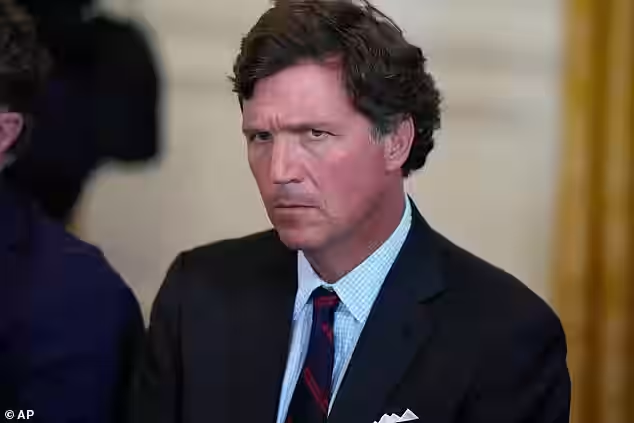
Speaking to conservative commentator Tucker Carlson, Huckabee suggested that it “would be fine” if Israel took control of all the land he discussed, citing biblical interpretations of land promised to Abraham’s descendants.
Though Huckabee later described his words as “hyperbolic,” the remarks drew swift criticism from Arab nations, including Egypt, Jordan, Saudi Arabia, Kuwait, and Oman, as well as from international organizations like the League of Arab States and the Organization of Islamic Cooperation.
Story So Far
Huckabee’s interview aired amid rising tensions between the US and Iran, which has been under scrutiny for its nuclear program.
Satellite images show the US has deployed over 60 attack aircraft to Jordan, triple the usual number, and additional forces to Portugal, fueling speculation of potential military action.
During the interview, Carlson framed the discussion around biblical land claims stretching from the Nile to the Euphrates, covering parts of modern-day Israel, Jordan, Syria, Lebanon, Iraq, and Saudi Arabia.
Huckabee suggested that Israel has a right to maintain security over the land it currently holds but stopped short of endorsing expansion into neighboring nations.
Huckabee has a long record opposing a two-state solution for Israelis and Palestinians. He has questioned the legitimacy of referring to Arab descendants in the region as “Palestinians” and has repeatedly expressed skepticism about granting them statehood.
International Reactions
Huckabee’s words triggered immediate condemnation.
-
Saudi Arabia called the comments “extremist rhetoric” and demanded clarification from the US State Department.
-
Egypt labeled them a “blatant violation” of international law, emphasizing that Israel has no sovereignty over occupied Palestinian or other Arab lands.
-
The League of Arab States said such statements “serve only to inflame sentiments and stir religious and national emotions.”
There has been no immediate official comment from Israel or the US government, though the White House and Huckabee have been contacted for statements.
Historical Context
Since its founding in 1948, Israel has never had fully recognized borders. Wars, annexations, and peace agreements have continuously reshaped the region:
-
In 1967, during the Six-Day War, Israel captured the West Bank and East Jerusalem from Jordan, Gaza and the Sinai Peninsula from Egypt, and the Golan Heights from Syria.
-
Israel withdrew from the Sinai Peninsula after the 1973 war as part of a peace agreement with Egypt and pulled out of Gaza in 2005.
-
Recently, Israel has expanded Jewish settlements and outposts in the West Bank and implemented bureaucratic changes consolidating its control.
Suggested Readings (News continues below)




Trump has publicly promised to block any annexation of the West Bank, while Palestinians continue to demand an independent state encompassing the West Bank and Gaza, with East Jerusalem as its capital—a claim supported by much of the international community.
Impact and Consequences
Huckabee’s comments risk further straining US relationships with Middle Eastern allies at a time of heightened tensions with Iran.
-
Diplomatic trust between the US and Arab nations may erode, complicating negotiations over regional security.
-
The remarks could inflame public opinion across the Middle East, potentially exacerbating anti-US sentiment.
-
They may embolden hardliners in Israel or the US who favor expansionist policies, while weakening moderate voices calling for peaceful resolution.
Meanwhile, ongoing conflicts in Gaza, Syria, and Lebanon continue to create a volatile regional landscape, with Israel recently retaining control over buffer zones in Syria and hilltop posts in Lebanon following prior clashes.
What’s Next
Attention will now turn to:
-
How the White House and US State Department respond to these international condemnations.
-
Possible diplomatic interventions by Egypt, Jordan, Saudi Arabia, and other Arab states.
-
The impact on US-Iran relations, especially in light of military deployments in Jordan and Portugal.
-
Continued developments in the West Bank and Gaza, as Israel maintains security control while Palestinian authorities push for recognition and statehood.
Observers will also watch for further statements from Huckabee, Carlson, or other political figures attempting to clarify or justify the remarks.
Summary
Mike Huckabee’s recent comments about Israel’s right to land have ignited a storm of criticism across the Middle East and raised tensions within US diplomatic circles.
Rooted in biblical interpretation and longstanding political views, the remarks have brought international law, historical conflicts, and current regional instability into the spotlight.
How the US responds could influence diplomatic ties, regional security, and ongoing debates over Israeli and Palestinian sovereignty.
Bulleted Takeaways
-
US ambassador Mike Huckabee suggested Israel could take control of all land promised to Abraham’s descendants during a Tucker Carlson interview.
-
Arab nations and international organizations condemned the remarks as extremist and a violation of international law.
-
Carlson faced accusations of anti-Semitism after raising controversial claims in the same interview.
-
Tensions between the US and Iran are escalating, with major US military deployments to Jordan and Portugal.
-
Israel has historically shifted borders through wars, annexations, and peace agreements since 1948.
-
The West Bank and East Jerusalem remain contested, with recent Israeli expansion and settlement policies drawing criticism.
-
Trump has pledged to block any annexation of the West Bank.
-
Palestinians continue to seek an independent state recognized by the international community.
-
Huckabee’s long opposition to a two-state solution underpins his controversial remarks.
-
Diplomatic consequences could include strained US-Arab relations and increased regional volatility.
