
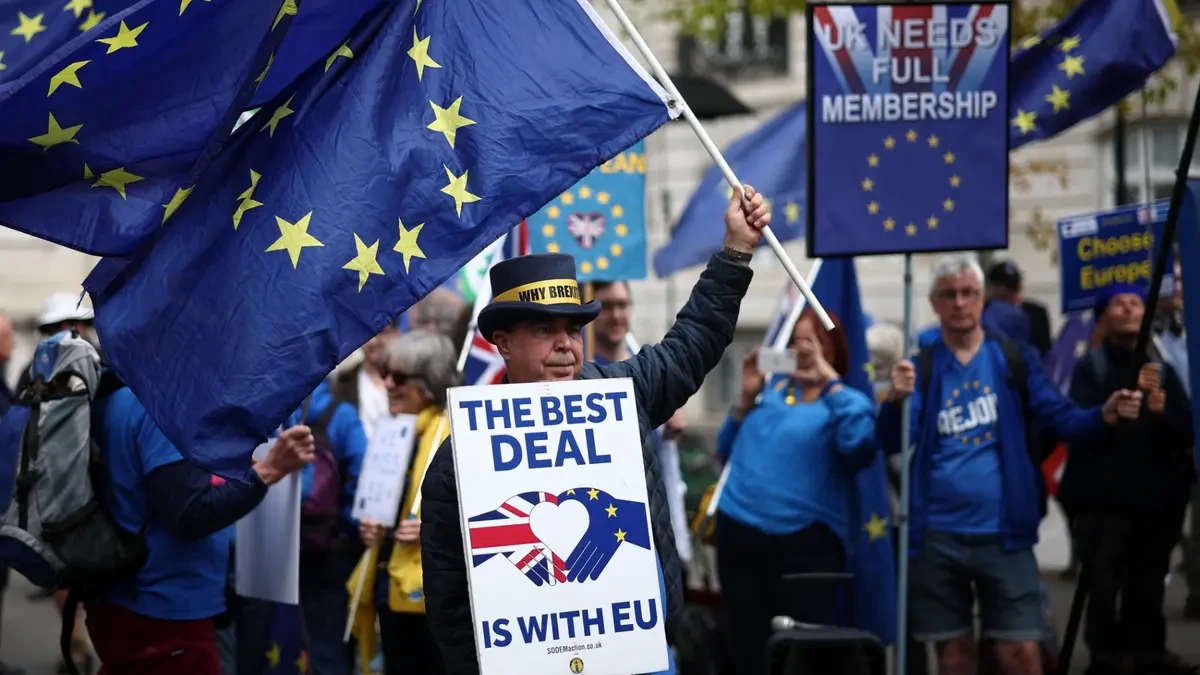
European Union and United Kingdom leaders are scheduled to meet in Brussels on November 20 for their second post-Brexit summit, with negotiations on closer cooperation expected to dominate discussions.
The meeting was initially planned for July but was postponed following the resignation of UK Prime Minister Keir Starmer. It will now take place under Prime Minister Andy Burnham, who has called for a national debate about Britain’s future relationship with the EU, including the possibility of rejoining the bloc and restoring freedom of movement.
Despite the change in political leadership and renewed discussion about closer ties, the summit’s immediate agenda remains focused on negotiations launched during the previous EU-UK summit in May 2025.
Ian Bond, Deputy Director of the Centre for European Reform, told The Local that the discussions would cover a relatively limited number of issues, although reaching agreements on several of them had proved difficult.
He said both sides were likely to present the meeting as a success, despite unresolved disagreements.
Agricultural Trade and Energy Agreements Among Priorities
European Trade Commissioner Maroš Šefčovič told the European Parliament that the EU wanted to conclude negotiations as a package covering agricultural trade, links between the two sides’ carbon markets and a youth experience scheme.
Talks are also continuing over British participation in the EU electricity market.
Bond identified a sanitary and phytosanitary agreement covering food and agricultural products as one of the areas most likely to be resolved. Under the proposed arrangement, the UK would commit to following EU rules in the sector, helping remove barriers affecting agricultural trade.
The two sides are also seeking an agreement on linking their emissions trading systems and allowing the UK to participate in the EU electricity market.
Bond said both sides had an interest in energy cooperation, particularly through offshore wind infrastructure in the North Sea. Differences in peak electricity demand between the UK and EU could allow electricity generation capacity to be transferred across the Channel when needed.
However, the EU is seeking a substantial financial contribution from Britain to its cohesion fund in exchange for access to the electricity market. The fund supports efforts to reduce economic and regional disparities across EU member states.
Youth Mobility Scheme Remains Major Obstacle
Negotiations over a youth mobility arrangement are among the most difficult items on the summit agenda.
The proposed scheme would allow people aged between 18 and 30 to live, work and travel between the UK and EU for up to three years without requiring employer sponsorship.
Thomas Byrne, Ireland’s Minister for Europe, told the European Parliament that the initiative was a central part of efforts to rebuild connections between young people in Britain and the EU.
However, the UK and EU remain divided over the number of participants who would be allowed to use the scheme each year. Britain wants an annual limit on the number of young Europeans who could enter under the arrangement.



University Fees and Healthcare Charges Complicate Talks
The EU is also seeking concessions for European students who want to study at British universities.
Its proposals include allowing EU students to pay the same tuition fees as British students and exempting them from the Immigration Health Surcharge, which gives visa holders access to the UK’s National Health Service.
Since Brexit ended freedom of movement, students from EU countries have generally been required to pay higher international tuition fees, alongside visa costs and the health surcharge.
The Financial Times reported that Britain had offered a reduced-fee arrangement, but EU member states considered the proposal insufficient.
Bond said the issue also presented a financial challenge for British universities, many of which depend on higher tuition payments from international students.
If large numbers of European students became eligible for domestic tuition rates, universities could face funding shortfalls that might require government support.
Disagreement Over Where Young Britons Can Work
The UK is also seeking greater flexibility for British young people who want to work in different EU countries.
Under the proposal, young Britons could move between member states for employment, allowing them, for example, to work in Spain during the summer and Austria during the winter.
EU countries have instead argued that participants should receive permission to work in only one member state, without an automatic right to move elsewhere for employment.
Bond said decisions on work permits fall under the authority of individual EU member states rather than the European Commission.
Media reports have suggested that the youth mobility agreement could be postponed by six months to give negotiators more time to resolve the outstanding differences.
UK Seeks Access to Proposed Made in Europe Rules
The summit will also address whether British companies and industries should be included in the EU’s proposed Made in Europe provisions.
The initiative is intended to strengthen European manufacturing and reduce reliance on suppliers from countries such as China.
The proposed measures would affect public procurement and strategic industries, including electric vehicles, aluminium, steel and clean technologies. The EU wants to increase production within Europe in these sectors.
Whether the UK will be included in the arrangements remains part of the discussions.
Ukraine and Defence Cooperation on Foreign Policy Agenda
Foreign policy is another expected subject, with leaders set to address support for Ukraine and cooperation on defence.
Byrne also highlighted ongoing work between the two sides in areas including health security, policing, judicial cooperation and efforts to tackle irregular migration and networks involved in migrant smuggling.
These areas form part of wider efforts to strengthen relations beyond trade and economic agreements.
Future Relationship Could Extend Beyond Trade
Bond said the negotiations reflected longstanding differences in how Britain and the EU have viewed their relationship.
He argued that many people in the UK had traditionally regarded the EU primarily as a trading bloc rather than a political union.
While trade remains an important part of the relationship, initiatives such as youth mobility, free movement within the single market and the Erasmus+ programme also involve social connections and a shared sense of belonging.
Bond said successful completion of the outstanding agreements, alongside progress on additional areas of cooperation, could create a favourable environment for Burnham to begin a national discussion about Britain’s future relationship with the EU.
The November 20 summit is expected to assess progress on the negotiations and determine which agreements can be finalised.
