
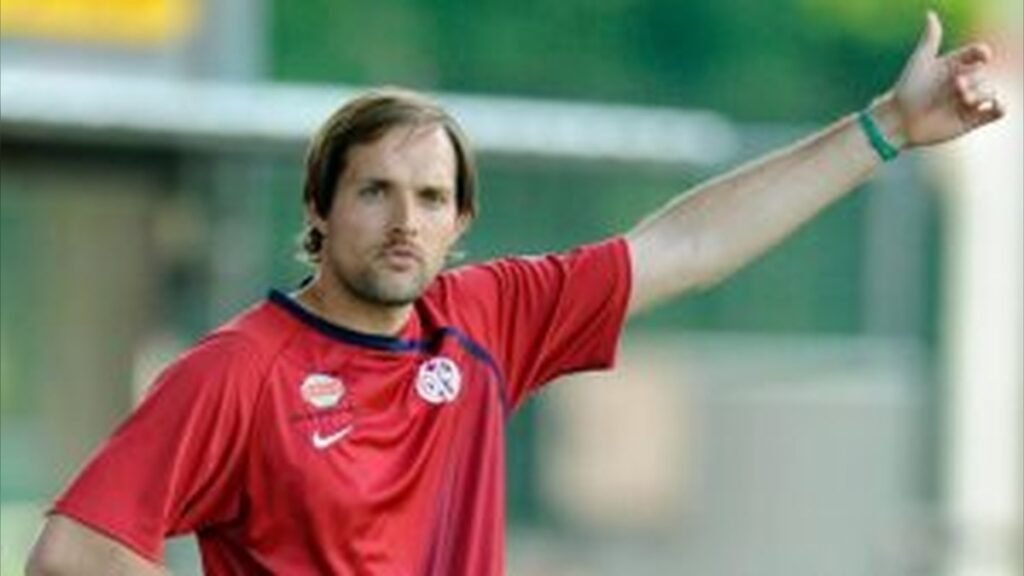
When England launched their 1998 World Cup campaign under manager Glenn Hoddle, Thomas Tuchel was far removed from the global football spotlight.
At the time, the future England boss was working shifts behind a bar in Stuttgart, trying to rebuild his life after an injury ended his playing ambitions.
Nearly three decades later, the German tactician has become the man entrusted with leading England’s quest for World Cup glory.
Renowned for his tactical intelligence, meticulous preparation and analytical approach, Tuchel’s rise to the top of world football is one of the sport’s most remarkable success stories.
The Career-Saving Call from Ralf Rangnick
Tuchel’s coaching career may never have happened without the intervention of fellow German coach Ralf Rangnick.
The two had previously worked together at SSV Ulm, where Rangnick had already begun implementing innovative tactical concepts that would later influence German football.
Tuchel, then a defender, was fascinated by the strategic side of the game and frequently questioned the reasoning behind training methods and match plans.
Years later, Rangnick learned that Tuchel was working in a Stuttgart bar to make ends meet.
Surprised by the news, he contacted his former player and encouraged him to return to football by accepting a youth coaching role at Stuttgart’s academy.
That opportunity would become the foundation of Tuchel’s future success.
Injuries End a Playing Dream
Before becoming one of Europe’s most respected coaches, Tuchel had hoped to enjoy a successful playing career.
However, persistent knee problems caused by cartilage damage severely limited his mobility.
Despite undergoing surgery in his early twenties in an attempt to continue playing, he eventually accepted that his football career was over.
The setback was devastating. His dream of reaching the Bundesliga disappeared, and financial difficulties followed.
Having previously paused his university studies to focus on football, Tuchel suddenly found himself without a career path and searching for work.
Life Behind the Bar
Determined to move forward, Tuchel relocated to Stuttgart and enrolled in a business administration program while taking a job at the popular Radio Bar.




The venue occupied part of the historic Radio Barth building, a former music retail landmark that became a temporary cultural hub after the original business collapsed in the mid-1990s.
During that period, the building evolved into one of Stuttgart’s most vibrant nightlife destinations.
The bar quickly became a gathering place for artists, musicians and members of Germany’s emerging hip-hop scene.
Tuchel initially handled basic duties such as collecting empty glasses before progressing to waiting tables and mixing drinks.
Although he later joked about the quality of his early cocktails, the experience proved invaluable.
Working with customers helped him develop confidence, communication skills and the ability to interact comfortably with strangers—qualities that would later benefit him as a manager.
Friendships Beyond Football
During his time at the Radio Bar, Tuchel formed friendships with several figures from Germany’s music scene, including rapper and musician Max Herre.
Herre later recalled that Tuchel became part of his social circle and regularly attended concerts, even traveling long distances to support performances.
The friendships highlighted a chapter of Tuchel’s life far removed from the football world that would eventually make him famous.
A Moment That Changed Everything
Despite Rangnick’s encouragement, Tuchel was initially hesitant about moving into coaching.
That changed dramatically in 1999 when his former club, Ulm, secured promotion to the Bundesliga.
Learning of the achievement while working a bar shift triggered an emotional reaction.
Watching others achieve the dream he had been forced to abandon convinced him that football was where he truly belonged.
Soon afterward, he committed himself fully to coaching.
Building a Reputation at Stuttgart
Tuchel began working with Stuttgart’s youth teams, first leading the under-15 side before becoming assistant coach to respected academy figure Hans-Martin “Hansi” Kleitsch at under-19 level.
Kleitsch was widely regarded as one of Germany’s leading youth developers and helped nurture future stars such as Sami Khedira and Mario Gomez.
Under Kleitsch and Tuchel, Stuttgart’s under-19 team captured the German youth championship in 2005, further enhancing the young coach’s growing reputation.
The Analyst Known as ‘The Man with X-Ray Vision’
While players admired Tuchel’s distinctive style and personality, it was his tactical expertise that truly set him apart.
Kleitsch famously described him as “the man with X-ray vision,” a nickname inspired by Tuchel’s extraordinary ability to analyze opponents and identify weaknesses.
According to those who worked alongside him, his match preparations were exceptionally detailed.
He consistently developed strategies tailored to specific opponents and earned a reputation for finding solutions that others overlooked.
Those analytical skills would later help him succeed at the highest levels of club football and ultimately earn him the England job.
England’s World Cup Mission
Today, Tuchel stands at the helm of the England national team, carrying the hopes of a nation desperate to end decades of World Cup disappointment.
After an unconventional journey that took him from injury-induced retirement and late-night bar shifts to the pinnacle of international football management, he now faces perhaps the greatest challenge of his career.
Nearly 30 years after serving drinks in Stuttgart, Tuchel’s task is clear: guide England to the World Cup title that generations of managers have failed to deliver.

