
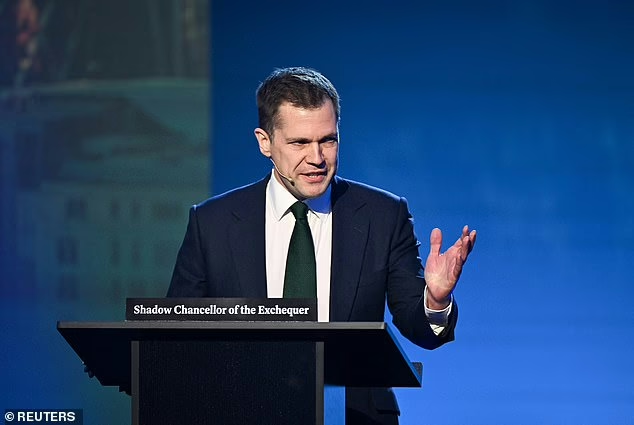
In a bold political move, Nigel Farage today revealed the first-ever ‘shadow cabinet’ for his Reform Party, signaling a serious push to position his party as a credible opposition to Labour.
Former Conservative minister Robert Jenrick was handed the role of shadow chancellor, despite having limited Treasury experience, setting the tone for a cabinet heavily populated by recent Tory defectors.
Farage described the lineup as a team ready to tackle Labour, while critics argue it looks more like a “Conservative tribute act” than a fully independent frontbench.
Key Appointments Shake Up Reform
Jenrick, once Housing Secretary under Boris Johnson, has now switched allegiance to Reform.
He told the audience that facing Chancellor Rachel Reeves would allow him to oppose what he called an economic “wrecking ball.”
Joining him on the frontbench:
-
Richard Tice, the party’s deputy leader, is lined up to be deputy prime minister and oversee a proposed “super department” for business, trade, and energy.
-
Zia Yusuf, party chairman, takes on the shadow home secretary role despite not being an MP or peer. He promised a tough stance on migration, calling illegal arrivals “the most profound betrayal of the British electorate in history.”
-
Suella Braverman, another ex-Conservative, becomes the party’s spokeswoman for education and equalities, pledging to scrap the equalities minister post if in government.
Farage emphasized that this frontbench of eight MPs shows Reform is ready to function as a genuine opposition force, countering claims that it is a “one-man-band.”
Policy Focus and Economic Ambitions
Tice outlined plans to supercharge the economy, promising up to 4% growth through energy development and creating a British wealth fund.




He also indicated a departure from net-zero targets, with a goal of “reindustrialising” and “reenergising” Britain.
Meanwhile, Yusuf’s rhetoric on migration has been fiery.
He outlined plans for strict deportation policies, arguing that illegal immigrants currently receive free housing, meals, and healthcare at enormous public expense.
Criticism and Polling Pressure
Not everyone is convinced by Farage’s new lineup.
Kevin Hollinrake, Conservative Party chairman, dismissed the frontbench as dominated by ex-Tories, lacking credibility as an alternative to the main parties.
Polling suggests the Reform lead may be slipping.
A YouGov survey put Farage’s party at 24%, down three points from last week, narrowing the margin over Labour at 19% and the Conservatives at 18%.
Even the Greens have gained a point to 17%, reflecting a crowded political field.
What’s Next?
The next few months will be critical for Reform.
Farage’s team will have to demonstrate cohesion, develop detailed policy plans, and show the electorate they can operate as a real alternative government.
Expect to see further scrutiny over the “shadow cabinet’s” experience, particularly Jenrick’s limited Treasury background, and whether the party’s ambitious economic promises are credible.
Migration policy, energy strategy, and education reform are likely to dominate media debates as the next election approaches.
Summary
Nigel Farage has unveiled the Reform Party’s first shadow cabinet, featuring ex-Tories Robert Jenrick, Suella Braverman, Richard Tice, and Zia Yusuf in key roles.
Jenrick takes the shadow chancellor role, Tice is positioned as deputy prime minister overseeing a “super department,” Yusuf handles migration as shadow home secretary, and Braverman leads on education and equalities.
While Farage claims this team positions Reform as the “real opposition to Labour,” critics argue it looks heavily Tory-influenced.
Polling shows the party’s lead narrowing, underscoring the challenge of turning a high-profile frontbench announcement into electoral traction.

