
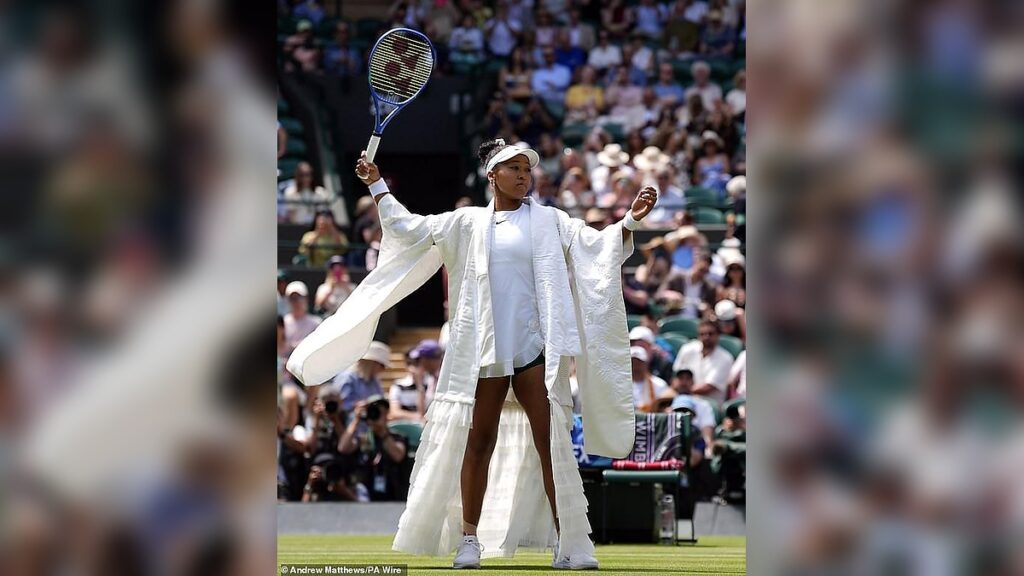
Naomi Osaka once again turned Wimbledon into a runway as well as a tennis stage, returning to her elaborate kimono-inspired entrance for her third-round clash against Daria Kasatkina on No. 1 Court.
After opting for a simplified version of the outfit during her second-round appearance, the four-time Grand Slam champion restored the complete ceremonial-inspired design for Friday’s match.
The dramatic ensemble featured its flowing ivory tulle train while being worn open over her all-white playing attire, although she chose to leave out the traditional obi belt that accompanied her first-round appearance.
Traditional Japanese Heritage Meets Wimbledon Tradition
Wimbledon is renowned for its strict all-white dress code, but Osaka has found a creative way to celebrate both the tournament’s heritage and her own cultural identity without violating the rules.
The custom-designed white kimono showcases intricate embroidered cranes and cherry blossoms—two enduring symbols deeply rooted in Japanese culture.
Additional design elements include oversized bell sleeves and detachable layers that transform the ceremonial garment into a dramatic walk-on outfit before revealing her match kit underneath.
Her green undershorts also comply with tournament regulations following Wimbledon’s 2022 amendment allowing female players to wear darker undershorts for comfort.
Inspiration Came From Culture and Cinema
Speaking about the concept behind the outfit after her opening-round victory, Osaka explained that Wimbledon immediately brings thoughts of tradition and history, which inspired her to reflect on her Japanese and Haitian heritage.
She said the kimono represented one of Japan’s most recognizable cultural silhouettes, noting that its distinctive shape remains instantly identifiable regardless of color.
Osaka also credited the iconic white kimono worn by Lucy Liu’s character in Kill Bill as another major influence.
She described her Wimbledon look as her own interpretation of that cinematic image while remaining respectful of Japanese culture.
Designer Blended Vintage Ceremonial Garments With Modern Fashion
Tokyo-based designer Hana Yagi created the striking outfit by incorporating elements of kirigami, the traditional Japanese paper-cutting art form.
According to the designer, the garment was assembled using vintage shiromuku bridal robes, traditional kimonos, and wedding dresses—ceremonial clothing originally worn to mark significant life events.
The finished creation also featured a traditional kanzashi hair ornament, historically associated with geisha, alongside elegant pearl jewelry from the luxury Japanese brand Mikimoto.
Crowd Reactions Made the Fashion Statement Even More Memorable
Osaka admitted she enjoyed the reaction her entrance generated around the grounds.




While walking toward the court wearing headphones, she noticed spectators physically turning to admire the outfit.
Hearing fans recognize it as a beautiful kimono made the experience especially meaningful for her.
The detachable design also created a theatrical reveal.
After greeting her first-round opponent, Elsa Jacquemot, Osaka removed the ceremonial layers courtside to unveil a specially embroidered white Nike match dress.
Fellow Players Were Curious About the Outfit
Osaka revealed that her fellow competitors were equally intrigued by the elaborate ensemble.
Several players questioned whether she owned multiple versions of the all-white garment and wondered what would happen if it became stained during the tournament.
Others even joked about whether dyeing the outfit would violate Wimbledon’s famous clothing regulations.
For Osaka, these conversations reflected how fashion has become an extension of her identity on tour, with players frequently asking about her increasingly creative Grand Slam entrances.
Fashion Statements Spread Across the Wimbledon Draw
Osaka has not been the only player embracing dramatic walk-on fashion at this year’s Championships.
American star Taylor Fritz arrived for his opening match wearing a custom all-white suit designed by Hugo Boss, complete with a matching holdall and headband that drew comparisons to Roger Federer’s classic Wimbledon appearance from 2007.
Although Fritz admitted he initially felt uncertain about the concept, he later said the photographs convinced him it had worked.
He also acknowledged that bold entrances carry added pressure, joking that losing in the opening round after such an entrance would make a player “look really stupid.”
Berrettini’s Fashion Plans Were Rejected
Not every player received approval for a custom walk-on look.
Italian star Matteo Berrettini disclosed that Wimbledon officials rejected his planned entrance outfit because its shade was considered slightly off-white with brown undertones, making it incompatible with the tournament’s famously strict dress code.
Despite the disappointment, Berrettini accepted the ruling and moved on without further complaint.
Osaka Continues to Blend Tennis With High Fashion
Osaka’s Wimbledon appearance continues a season-long series of fashion-forward Grand Slam entrances.
Earlier this year at French Open, she attracted widespread attention with a sparkling gold outfit inspired by the illuminated Eiffel Tower, along with upcycled jackets and skirts crafted from previous tennis outfits.
Those looks sparked debate after her first-round opponent, Laura Siegemund, suggested Osaka appeared more focused on creating a fashion spectacle than playing tennis.
Others strongly disagreed. Jacquemot praised both the craftsmanship and attention to detail behind Osaka’s Wimbledon attire, while Donna Vekic defended the creative expression, arguing that fashion offers athletes another way to showcase their personalities.
A Distinctive Identity Beyond the Court
Osaka has built a reputation for treating Grand Slam arrivals as opportunities for artistic expression.
Her recent creations include a jellyfish-inspired outfit at the Australian Open, bold tribal-inspired accessories at Indian Wells Open, and a dramatic transformation at the Met Gala featuring a blood-red crystal gown designed to resemble exposed muscle beneath a feathered outer coat.
Despite the occasional criticism, Osaka has remained committed to merging elite sport with fashion.
She has explained that Grand Slam walk-ons represent the rare moments when she feels less like an athlete and more like an entertainer, giving her the opportunity to celebrate creativity alongside competition.
