
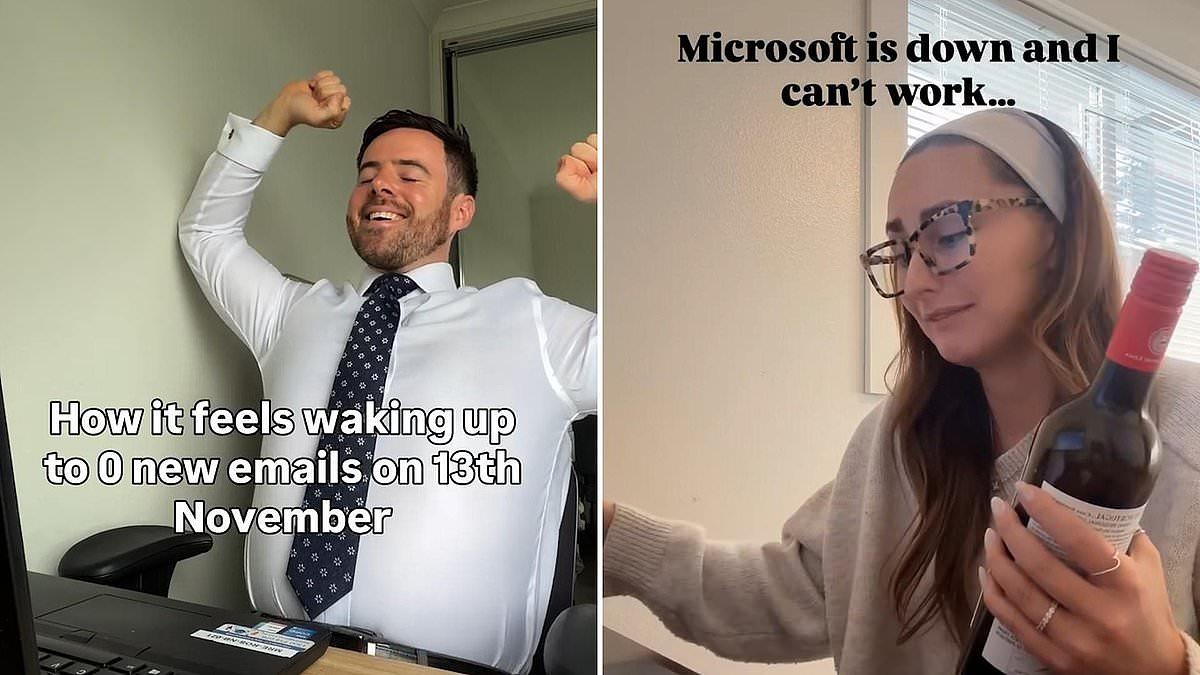
Microsoft’s widespread service outage has prompted a flood of humorous reactions online, with office workers sharing memes and jokes as they struggle to carry on with their daily responsibilities without access to essential workplace tools.
The disruption has affected several widely used services, including Outlook, Microsoft Teams, Copilot and Microsoft 365, leaving employees across different industries unable to access platforms relied upon for everyday business operations.
Although the outage has caused significant disruption, it has not stopped users from finding humour in the situation.
‘Outlook Not So Good’ Becomes the Internet’s Favourite Joke
Among the most popular reactions circulating on social media is the phrase ‘Outlook not so good’, a reference to Microsoft’s email service, which has been among the platforms affected.
Another widely shared joke involves the Microsoft 365 logo, with users altering the number to read ‘Microsoft 364’ in response to the company‘s service disruption.
One post featured George Costanza, the famously unproductive character from the 1990s sitcom Seinfeld, drumming on his desk with pencils.
The accompanying caption read: ‘Everyone in corporate America right now with nothing to do in the office.’
Another social media user shared an animated scene featuring Ed Helms from The Office, showing him opening a bottle of Jägermeister and preparing shot glasses.
The post was captioned: ‘Microsoft down in the middle of the work day.’
Meanwhile, an image of the popular ‘This Is Fine’ dog meme, depicting a character calmly drinking coffee while surrounded by flames, was shared alongside the complaint: ‘Microsoft outage on one of my busiest days.’
Clippy’s Revenge and Jokes About Returning to the Past
The outage has also revived jokes about Clippy, Microsoft’s former animated assistant in Word, which was frequently criticised by users for its unwanted interruptions.
An X user shared an image of the retired paperclip mascot with the caption ‘Clippy’s revenge’, suggesting the disruption was payback from the once-unpopular feature.
Other users turned their attention to older communication technologies, joking that the breakdown could force businesses to abandon modern digital services.
One post warned: ‘Get ready folks – for FAX.’
Encyclopaedia Britannica, the publisher known for its printed reference books, joined the conversation by highlighting the reliability of its traditional publications.
Sharing a reference to its encyclopaedias, the company wrote: ‘Unlike Microsoft Outlook, these bad boys never go down.’
Another user posted an animated image of Fred and Barney from The Flintstones, accompanied by the caption: ‘Looks like we are going back to the stone age.’
Microsoft’s Technical Updates Become Another Target
While users have found entertainment in the situation, some have directed their frustration towards Microsoft’s explanations of its recovery efforts.
The company’s technical updates have attracted criticism for relying on complicated language rather than providing straightforward information about the problem and its expected resolution.
After Microsoft announced that it was ‘opening all available pathways to restore service’, communications expert Sharan Kaur questioned the wording.
She wrote: ‘Does Microsoft not have a comms team? Because who on earth approved this messaging?’
Other users have mocked the company’s engineers as they attempt to identify the source of the disruption.
One post featured a photograph of a heavily tangled telegraph pole, with the caption: ‘Microsoft engineers have narrowed down the problem.’




Another showed a man surrounded by cables beneath a server rack, accompanied by the description: ‘The person at Microsoft trying to figure out which cord to plug back in to fix Outlook.’
Office Workers Ask Microsoft to Delay Its Recovery Efforts
As the disruption continued into Friday, some employees began joking that Microsoft should take its time restoring services, particularly with the weekend approaching.
One user shared a mock letter addressed to the technology company, which read: ‘Dear Microsoft, No rush. Take your time.
Spend time with your family. Prioritize your mental health. Sincerely, every corporate employee.’
Another post suggested that the company could wait until 5pm on Friday before resolving the problem.
A separate user joked: ‘The only thing Outlook delivered on time today was happy hour.’
However, not everyone was comfortable with the prospect of the outage continuing.
One employee warned that the situation could become even more chaotic once services returned and accumulated emails began arriving simultaneously.
‘It won’t be so fun when suddenly all the emails start downloading at 4.45pm,’ the user wrote.
Global Microsoft Outage Disrupts Essential Public Services
Beyond the online jokes, the disruption has created significant operational difficulties for organisations that depend on Microsoft’s services.
The outage began at approximately 6pm GMT on Thursday and continued into Friday, with the company still working to restore affected platforms more than 12 hours later.
More than 430 million people use Microsoft’s collection of online applications, although the company has not confirmed the total number of customers affected by the incident.
In the United Kingdom, government departments have activated contingency arrangements to minimise disruption, while several public services have reported difficulties.
The National Health Service has also experienced problems because of its reliance on Microsoft 365.
Workers on the NHS 111 helpline have been unable to refer patients to other services as usual, creating concerns about growing backlogs.
Rachel Harrison, national secretary of the GMB union, told Sky News: ‘This is creating a massive backlog and has the potential for chaos.’
Hospitals, general practitioner practices, pharmacies, police forces and local councils have also been affected by the disruption.
The UK Government has said robust contingency plans are in place to limit the impact on essential services.
Microsoft Outage Renews Concerns About Global Technology Dependence
The incident has renewed questions about the extent to which governments, businesses and public infrastructure depend on a relatively small number of major technology providers.
It follows several other significant technology disruptions that have affected organisations and consumers worldwide.
Last month, a power-related problem at a Google Cloud data centre in London disrupted services used by financial institutions, including Revolut, HSBC, Barclays and Lloyds.
Remote court hearings and Royal Mail operations were also affected.
In October 2025, an Amazon Web Services DNS problem disrupted access to several online platforms, including banks, social media services and the video game Fortnite.
The incident lasted approximately 15 hours.
Another major disruption occurred in 2024 when a faulty cybersecurity update released by CrowdStrike caused computers across the world to crash.
Airports, banks, broadcasters, retailers and government organisations were among those affected.
Although CrowdStrike released a correction shortly after identifying the problem, restoring affected systems took several days because many computers required manual restarts.
The incident resulted in more than one million air passengers experiencing cancelled or delayed flights.
Fortune 500 companies also suffered an estimated £4.2 billion in losses, making it one of the most disruptive technology outages on record.
Technology Analyst Questions Microsoft’s Prolonged Disruption
The continuing problems have also attracted criticism from technology industry observers.
Ed Zitron, a technology analyst and journalist whose podcast is titled Better Offline, expressed his frustration in a post on X.
He wrote: ‘What the f*** is going at Microsoft?’
Zitron also criticised the length of time Outlook had remained unavailable, questioning the company’s ability to restore such an important service.
He described the prolonged disruption as unacceptable and called for Microsoft chief executive Satya Nadella to be dismissed, while acknowledging that such an outcome was unlikely.
Despite the widespread memes and jokes, the outage has continued to expose the difficulties faced by organisations and employees when essential digital infrastructure becomes unavailable.
