
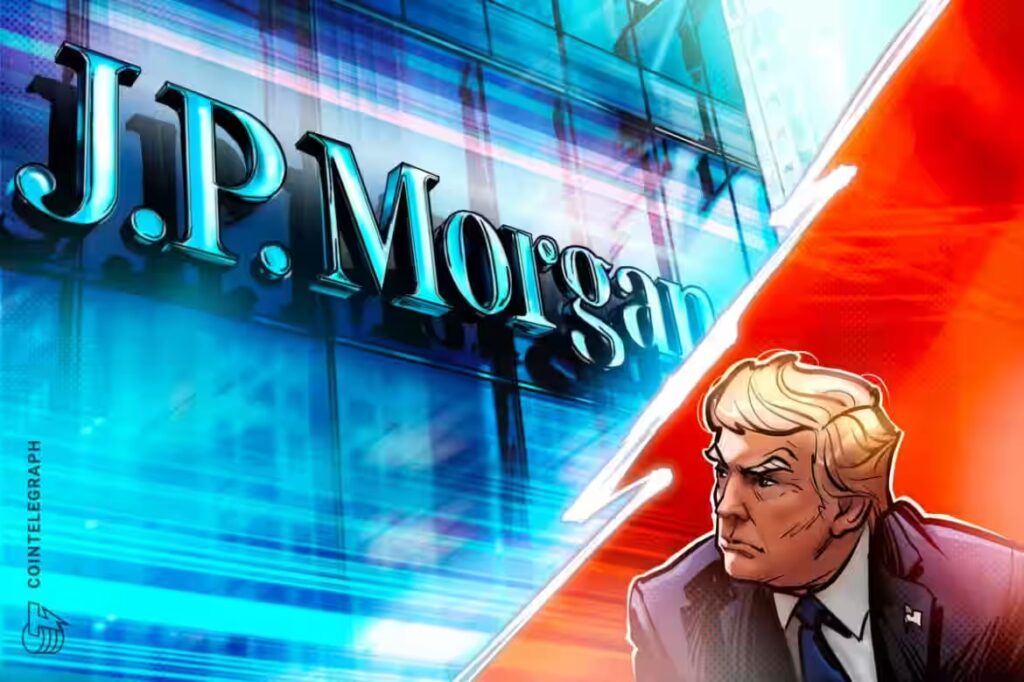
For the first time, JPMorgan has openly confirmed that it closed accounts tied to former President Donald Trump following the January 6, 2021 Capitol attack — a move that arguably nudged the Trump family toward the world of cryptocurrency.
Dan Wilkening, JPMorgan’s former chief administrative officer, acknowledged in court filings last week that the bank decided to shutter Trump-linked accounts, something the bank had previously avoided admitting publicly.
According to Wilkening, “In February 2021, JPMorgan informed Plaintiffs that certain accounts maintained with JPMorgan’s CB [commercial bank] and PB [private bank] would be closed.”
Trump’s Lawsuit Alleges Political Motivation
The closure of accounts quickly became the center of a high-profile lawsuit.
Filed in late January, Trump’s case alleges that JPMorgan de-banked him, his family, and his businesses purely for political reasons.
The lawsuit seeks $5 billion in damages, claiming reputational harm and financial disruption.
Trump’s legal team called the acknowledgment a “devastating concession,” stating that it proves the former president’s claims.
“JPMorgan Chase admitted to unlawfully and intentionally de-banking President Trump, his family, and his businesses, causing overwhelming financial harm,” the statement read.
Meanwhile, JPMorgan spokesperson Trish Wexler told CNN that the bank regrets the lawsuit but stands by its practices.
“We believe the suit has no merit,” she said, emphasizing that account closures are typically due to legal or regulatory risk — not political or religious motivations.
Debanking and the Family’s Move Into Crypto
The account closures had wider consequences.




Eric Trump, the former president’s son, said the family leaned heavily into cryptocurrency after being effectively barred from traditional banking channels.
He described the experience as transformative:
“Capital One stripped 300 bank accounts from me in the middle of the night,” Eric Trump told Fox News in August last year.
“It forced us to adopt crypto, and it has become the fastest-growing industry anywhere in the world.
It has removed a lot of the power from the big banks, who have weaponized their platforms against the American people.”
This shift ultimately led Eric Trump to spearhead the creation of the Trump family’s crypto platform, World Liberty Financial, while Donald Trump has pushed for positive crypto regulation during his second stint in the White House.
Crypto as an Alternative to Traditional Banks
The Trump family’s story highlights a broader trend: for individuals and businesses frustrated with traditional banking, cryptocurrency offers an alternative financial ecosystem.
Platforms like WLFI aim to provide access to decentralized finance, allowing users to transact and store value outside the influence of major banks.
Some analysts see the move as a lesson in how political or regulatory risk can accelerate the adoption of blockchain technologies, especially among high-profile figures who find themselves “debanked” unexpectedly.
What’s Next?
The legal battle between Trump and JPMorgan is far from over.
If the lawsuit succeeds, it could set a precedent for how banks handle politically connected accounts.
Meanwhile, the Trump family appears committed to expanding its crypto ventures, likely continuing to lobby for regulatory frameworks that favor innovation in digital assets.
Investors and observers will also be watching whether this high-profile shift influences other individuals and corporations who may feel at risk from traditional banking institutions, potentially accelerating crypto adoption in unexpected sectors.
Summary
JPMorgan has publicly confirmed it closed accounts linked to Donald Trump following the January 6 Capitol attack, marking the first official acknowledgment of de-banking.
Trump alleges the closures were politically motivated and is seeking $5 billion in damages.
The account shutdowns prompted the Trump family to explore cryptocurrency, leading to the creation of the World Liberty Financial platform and a broader embrace of digital assets as an alternative to traditional banks.
The legal and financial repercussions of this move continue to unfold.

