
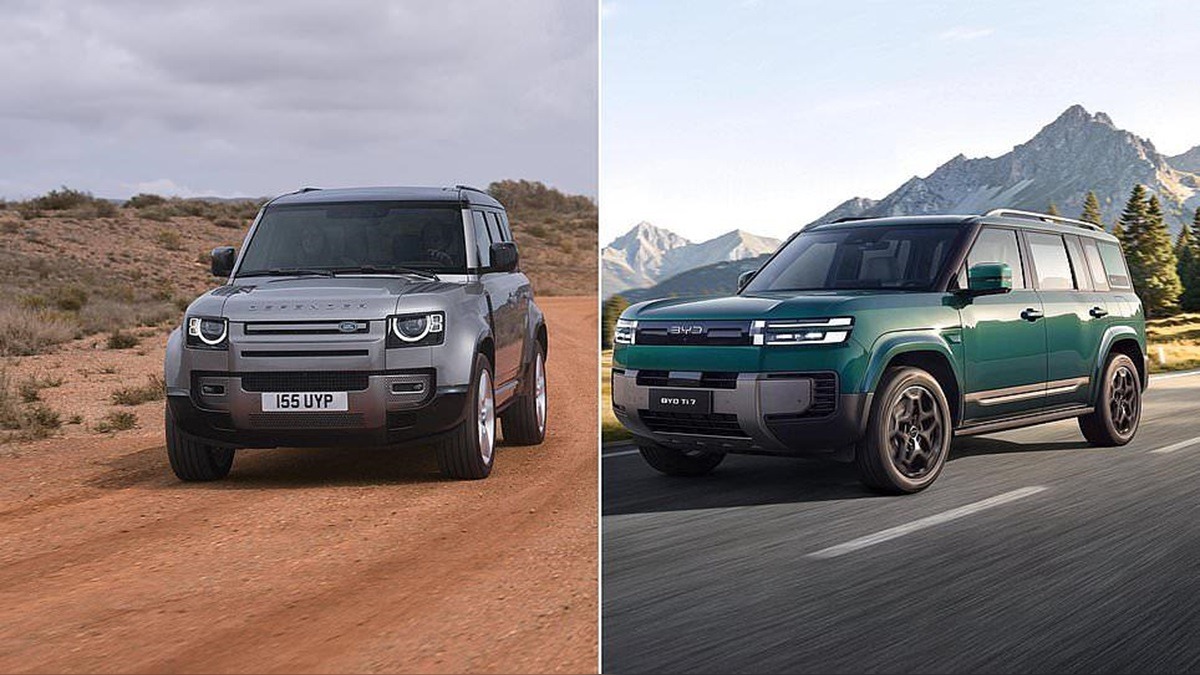
Jaguar Land Rover (JLR) has suffered an early legal setback in its intellectual property dispute with Chinese automaker BYD after a Dutch court ordered it to destroy or return documents seized from the company’s offices.
The ruling, delivered on Wednesday by a court in The Hague, followed a challenge by BYD over searches conducted at two of its Dutch offices in August.
JLR must comply with the order or face financial penalties of up to €500,000 (£418,000).
The dispute centres on allegations that BYD copied the distinctive design of JLR’s popular Land Rover Defender for its upcoming Ti7 seven-seat SUV.
Dutch Court Rules Against Jaguar Land Rover
Judge Hugo van Heemstra ruled that the documents obtained during the August searches were not necessary to establish whether BYD had infringed JLR’s intellectual property rights.
The court ordered the British manufacturer to destroy the seized material or return it to BYD within 24 hours of the ruling.
JLR faces a penalty of €50,000 (£41,800) for every hour it fails to comply, subject to a maximum fine of €500,000 (£418,000).
The company was also directed to pay BYD €25,376.57 (£21,200) towards its legal expenses.
The ruling followed an application by BYD, which accused JLR of conducting an excessive search of its offices in Schiedam and Hoofddorp.
BYD Accuses JLR of Conducting a Fishing Expedition
The searches were organised by JLR in August to obtain digital records relating to the planned introduction of the Ti7 in European and UK markets.
Documents recovered from BYD’s Dutch headquarters reportedly included information about the sourcing and launch preparations for the new SUV.
BYD argued that the searches went beyond what was necessary for the design infringement allegations, describing the exercise as a fishing expedition.
The Chinese automaker also maintained that the seized digital material contained technical and commercially sensitive information.
During Wednesday’s hearing, the court found that the evidence was not relevant to JLR’s copying allegations or any potential financial compensation claims, particularly because the Ti7 had not yet entered the European market.
JLR Pursues Two Legal Actions in the Netherlands
JLR selected the Netherlands for its legal battle against BYD because of the country’s established intellectual property laws and history of decisions favouring intellectual property rights holders.
The British manufacturer has initiated separate proceedings in The Hague and Rotterdam.
The case in The Hague concerns alleged infringement of the design rights associated with the Defender, while the Rotterdam proceedings involve allegations of copyright infringement and slavish imitation of the vehicle.
JLR maintains that BYD deliberately reproduced the appearance of the latest-generation Defender rather than independently developing an SUV with a similar boxy design.




The British manufacturer has not publicly commented on the latest court ruling, with a spokesperson telling the Daily Mail and This is Money that the company does not comment on ongoing legal proceedings.
BYD representatives have also declined to comment.
BYD Ti7 Set to Challenge Defender With Lower Price
The legal dispute comes ahead of the expected arrival of BYD’s seven-seat Ti7 SUV in UK showrooms in early 2027.
The vehicle is expected to start at £47,995, making it considerably cheaper than comparable versions of the Land Rover Defender.
The Ti7 is approximately £21,000 less expensive than the entry-level Defender 110 and around £35,000 cheaper than the extended-wheelbase Defender 130, which comes with seven seats as standard.
The price difference places the Chinese SUV in a competitive position against JLR’s established luxury off-roader.
JLR is expected to seek an injunction preventing BYD from selling the Ti7 in European showrooms as the main intellectual property dispute proceeds.
However, there are concerns that the legal proceedings may not be concluded before the vehicle reaches UK dealerships.
Ti7 Combines Plug-in Hybrid Technology With Boxy Design
BYD’s Ti7 features a plug-in hybrid powertrain combining a 1.5-litre turbocharged four-cylinder petrol engine with two electric motors, one fitted to each axle.
The SUV also has a 35.6kWh lithium iron phosphate battery, with BYD claiming an electric-only driving range of up to 102 miles.
The vehicle can accelerate from zero to 62mph in 4.8 seconds.
Measuring 5,146mm in length, 1,995mm in width and 1,865mm in height, the Ti7 sits between the Defender 110 and Defender 130 in terms of overall dimensions.
BYD describes its exterior as an unapologetically boxy profile, highlighting its imposing proportions and chunky styling as features designed to appeal to SUV buyers.
JLR, however, argues that the similarities go beyond a shared preference for boxy SUV styling and amount to an infringement of its protected design and intellectual property rights.
Chinese Car Brands Expand Their Presence in the UK
JLR’s dispute with BYD comes as Chinese vehicle manufacturers continue to increase their share of the British automotive market.
Demand for Chinese-made vehicles has grown over the past two years, with buyers attracted by competitive prices, extensive equipment and designs that compete with established European and Japanese brands.
Figures cited in the report show that Chinese manufacturers accounted for 21.6 per cent of new cars registered in the UK in October.
British motorists have ordered almost 338,000 vehicles from Chinese brands since the beginning of 2026, representing 18 per cent of all new registrations so far this year.
BYD alone has sold almost 75,000 vehicles in Britain during the period.
That figure represents nearly one in every 25 of the 1.892 million new cars registered in the UK during the first ten months of 2026.
JLR Has Previous Experience With Vehicle Design Disputes
The legal action against BYD is not the first time JLR has attempted to prevent another manufacturer from producing a vehicle it considers too similar to one of its models.
In 2020, the company lost its attempt to trademark the shape of the original Defender in a case involving Ineos and its Grenadier off-roader.
JLR had sought to prevent billionaire businessman Sir Jim Ratcliffe from introducing the Grenadier, which was designed as a spiritual successor to the original Defender.
However, the company previously secured a significant legal victory in China in 2019 against Jiangling Motor Corporation.
A court in Beijing ruled that the company’s Landwind X7 had copied five distinctive design features of the Range Rover Evoque.
The latest dispute with BYD is unfolding alongside developments involving another Chinese luxury automotive brand.
BYD’s premium subsidiary, Yangwang, has unveiled a flagship limousine whose design has drawn comparisons with the Rolls-Royce Phantom.
The vehicle is expected to cost approximately half the price of the British luxury model.
