
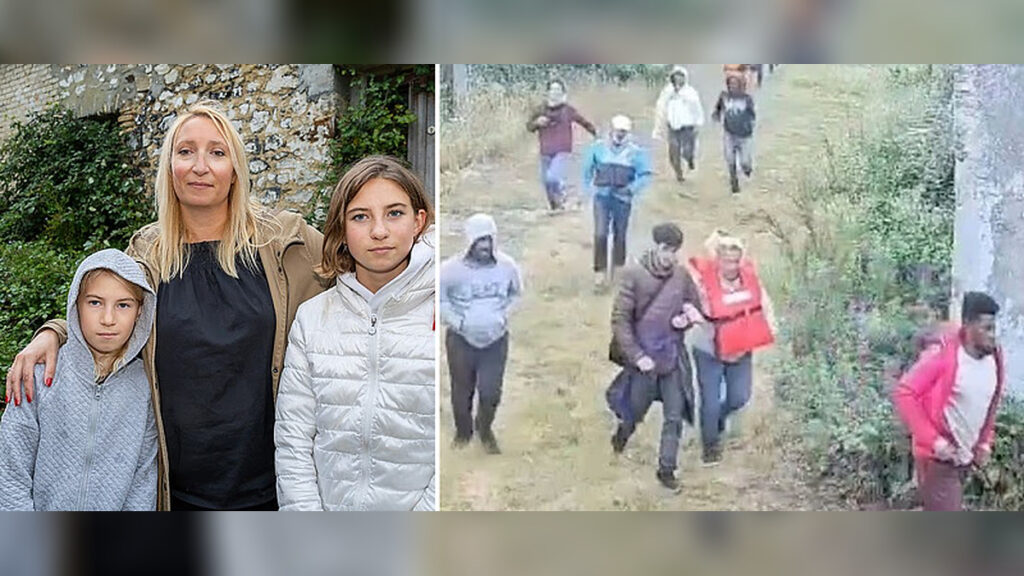
A mother living along France’s northern coastline says the migrant crisis across the English Channel has transformed the area around her family home, with groups of migrants now passing close to her property as they attempt to reach boats bound for Britain.
Héloïse Longuet, 44, said her family’s 19th-century farmhouse near Neufchâtel-Hardelot, south of Boulogne-sur-Mer, was once a peaceful holiday property undergoing renovation.
She now says the surrounding area has become a gathering point for migrants waiting for instructions from people smugglers.
CCTV captures migrants heading towards the beach
Longuet has released CCTV footage showing groups of young men wearing life jackets moving quickly past her property as they make their way towards the coast.
She said migrants frequently gather outside the house while checking their phones for coordinates provided by smugglers before attempting to reach the beach.
Although there is no direct route to the shoreline across her land, Longuet said that has not prevented people from entering the property.
She has recorded at least three such incursions and installed surveillance cameras accompanied by warning signs in an effort to deter further trespassing.
Makeshift camps emerge around the property
The mother of two said the situation has become increasingly unsettling, with makeshift camps appearing in woodland close to the farmhouse.
Longuet described seeing migrants living in poor and unsanitary conditions and said rubbish has been left behind in the surrounding countryside.
“It is very frightening,” she said, explaining that her concerns have intensified because she has two young daughters and believes there is limited police protection in the area.
Her experience echoes concerns raised in parts of Britain where communities have protested against the presence of large numbers of predominantly male asylum seekers.
Hardelot becomes a new departure point
Hardelot beach has increasingly become part of the Channel migration route as criminal gangs look for less heavily monitored stretches of coastline.
Longuet said she had previously enjoyed walking her dog, Maurice, along the beach but has become increasingly distressed by the way smugglers have begun using the area.
The gangs have shifted activity away from more established departure points around Calais and Dunkirk, apparently seeking isolated locations where boats can be launched with less chance of immediate intervention.
Migrants can reportedly hide among the dunes before being taken towards overcrowded inflatable boats.
Deadly journeys underline the risks
The change in departure locations has coincided with a series of serious incidents.
Last month, a man in his 30s died when a small boat overturned off the coast, while six other people, including a toddler, were injured.
Two women also died from cardiac arrest in May after reportedly being suffocated aboard a vessel carrying more than 80 people that had departed from Hardelot.
Violence has also become a recurring feature of the crisis, with clashes between migrants and French security forces reported in the area.
Gendarmes and riot police have used tear gas during confrontations.




During periods of extreme summer heat, tensions were further heightened when several fires were reported around Hardelot.
Longuet says her concerns are not about hostility towards migrants
Despite her fears about the situation, Longuet insists that her position should not be interpreted as hostility towards migrants themselves.
The former estate agent said she had met migrants through her work and had developed considerable sympathy for people fleeing dangerous circumstances.
She recalled speaking to Afghans who had travelled towards France in groups, only for some members of their original group to die during the journey.
According to Longuet, some told her that as many as 12 people had initially left their home country together, but only two or three survived to reach France.
“As a mother, I wouldn’t like to imagine the horrors they go through. I pity them,” she said.
For Longuet, the central issue is not simply French or British political debate but the international networks that profit from desperate people seeking safer lives.
Smuggling gangs accused of exploiting desperate people
Longuet said she believes people smugglers are at the heart of the crisis, turning dangerous Channel crossings into a lucrative criminal enterprise.
“They are a business, and all they are interested in is the money,” she said.
Migrants can reportedly be charged around £1,000 for a place on overcrowded inflatable boats, despite the considerable risk involved in crossing one of the world’s busiest waterways.
Longuet said she believes the wider problem begins well before migrants arrive in France and cannot be resolved solely through domestic political measures.
Mayor says hundreds can gather in the town
Paulette Juilien-Peuvion, the mayor of Neufchâtel-Hardelot, said the number of migrants gathering in the town can reach around 600 at a time.
She said residents had expressed concerns about going outside at night, particularly around wooded areas.
The mayor acknowledged the conflicting emotions surrounding the crisis, with some people viewing the migrants’ journeys as a tragedy while others are primarily concerned about their own safety.
“Some say that, ultimately, these people left everything behind for an adventure – it’s a tragedy. And others say, ‘We feel unsafe’,” she said.
French authorities point to increased policing
French authorities maintain that the situation is improving as policing and cooperation with Britain intensify.
An Interior Ministry source in Paris said officers had prevented 185 small-boat crossings during the four months following a new Anglo-French agreement signed in April.
The agreement involves around £660 million in British funding for French efforts to combat irregular Channel migration.
French police say they have also arrested more suspected smugglers and seized boats, engines and life jackets, while a dedicated 50-member riot unit has been deployed.
Channel crossings fall despite record-sized boat journey
Official figures cited in the report indicate that 15,897 migrants have crossed the Channel so far this year.
That represents a 43 per cent decline compared with the same period last year and an 18 per cent reduction from the equivalent point in 2024.
Despite the overall fall, the scale of individual crossings remains a concern.
Last month, a record 230 people reportedly travelled from France to England aboard a single small boat.
Britain says pressure on criminal gangs is increasing
UK Home Secretary Shabana Mahmood said the latest cooperation with France was already producing results by disrupting crossings before boats could depart.
She said the British and French authorities were targeting the criminal organisations responsible for organising the journeys, with equipment being seized and smuggling operations disrupted.
Mahmood said joint efforts since the election had prevented more than 47,000 small-boat crossing attempts.
Longuet spends less time at her coastal property
Longuet is now permanently based elsewhere in northern France with her family and said she has reduced the frequency of her visits to Hardelot.
For a woman whose family farmhouse once represented a quiet retreat, the changing landscape has left her feeling increasingly uncomfortable about staying there.
Her story illustrates the competing realities along the French coast: migrants facing dangerous journeys organised by criminal networks, authorities attempting to prevent crossings, and local residents confronting a crisis that has moved increasingly close to their homes.
