
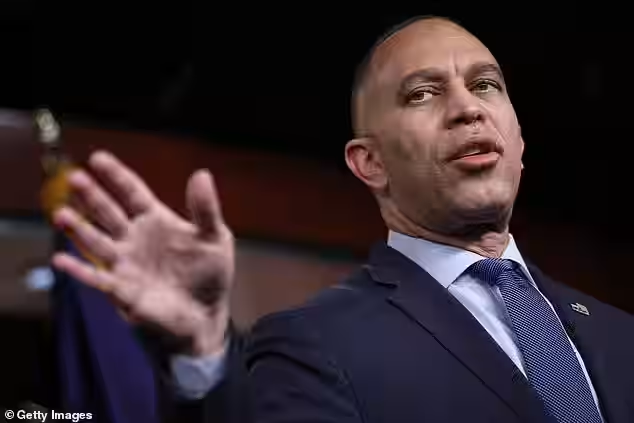
President Donald Trump wasted no time hitting back after Hakeem Jeffries called him a “wannabe king” following Friday’s Supreme Court ruling against his tariff policies.
The high court struck down Trump’s use of the International Emergency Economic Powers Act of 1977 to justify his broad tariffs, siding 6-3 against the White House.
Jeffries celebrated the decision on X, saying it was a “big victory for the American people” and a “crushing defeat for the wannabe King.”
At a White House briefing later that day, reporters pressed Trump on the comment.
Trump Doubles Down in White House Briefing
Trump fired back, deriding Jeffries as “low IQ” and suggesting he doesn’t even understand tariffs.
“I watched him the other day, interview, the guy doesn’t even know what a tariff is,” Trump said, mixing frustration with his signature combative style.
Despite the Supreme Court striking down his policy, Trump insisted he still retains authority to impose tariffs under other pre-existing statutes.
“I don’t have to push a new bill through Congress,” he said.
“I have the right to do tariffs and I’ve always had the right to do tariffs.
And it’s all been approved by Congress, so there’s no reason to do it.”
Legal Ruling vs. Political Reality
The court’s ruling puts Trump in a tricky legal position.
Using emergency powers to impose tariffs is no longer a viable path, but the President indicated he could achieve the same outcome through other laws.
Pushing a large tariff bill through Congress, however, would be politically difficult, especially with the midterm elections looming in November.




Republicans are expected to face tough races to maintain control of the House, making broad tariff legislation a hard sell.
Interestingly, some Republicans applauded the Supreme Court’s decision, and Wall Street reacted positively, highlighting the economic stakes tied to trade policy.
Trump, however, framed the ruling as a minor setback, emphasizing that party unity would ultimately carry him through.
The Canada Tariff Vote Drama
Trump also took issue with reports labeling the House vote to rescind Canadian tariffs as “bipartisan.”
Last week, the House voted 219-211 to end tariffs on Canada, with six Republicans joining Democrats to form the majority.
Trump disputed the characterization, insisting only “a few” Republicans broke ranks.
He repeatedly stressed Republican unity, pointing out the 215 votes his side secured, downplaying the three members who voted against him.
“There’s great unity in the Republican Party, and I hope everyone is going to vote Republican because otherwise you won’t have a country left,” he warned.
Trump’s Take on His Policy Future
Despite the Supreme Court setback, Trump signaled he would continue pursuing tariffs where possible without relying on new legislation.
He framed the issue as one of national importance, portraying opponents as threatening the country’s stability.
Observers note that any new tariff push would face resistance in Congress and would have to contend with economic and political realities, including potential backlash from trading partners and domestic industries.
What’s Next?
Trump’s legal and political strategy regarding tariffs is now in flux.
While he can explore other statutory avenues for imposing tariffs, the midterm elections will shape what is realistically achievable.
Republican lawmakers and business groups will be watching closely as Trump navigates both public opinion and legislative hurdles.
Meanwhile, rhetoric from the House, led by Jeffries, is likely to continue, setting the stage for further clashes over trade policy and presidential authority in the months ahead.
Summary
President Donald Trump responded angrily to Representative Hakeem Jeffries calling him a “wannabe king” after the Supreme Court struck down his use of emergency powers for tariffs.
At a White House briefing, Trump mocked Jeffries’ understanding of trade policy and reiterated that he still has the right to impose tariffs under other laws.
The ruling complicates Trump’s tariff agenda, especially with midterms approaching, but he insists he does not need new legislation.
Republican unity, the House vote on Canadian tariffs, and economic reactions all frame the ongoing battle between Trump, Congress, and the courts as the trade and political drama continues.

