
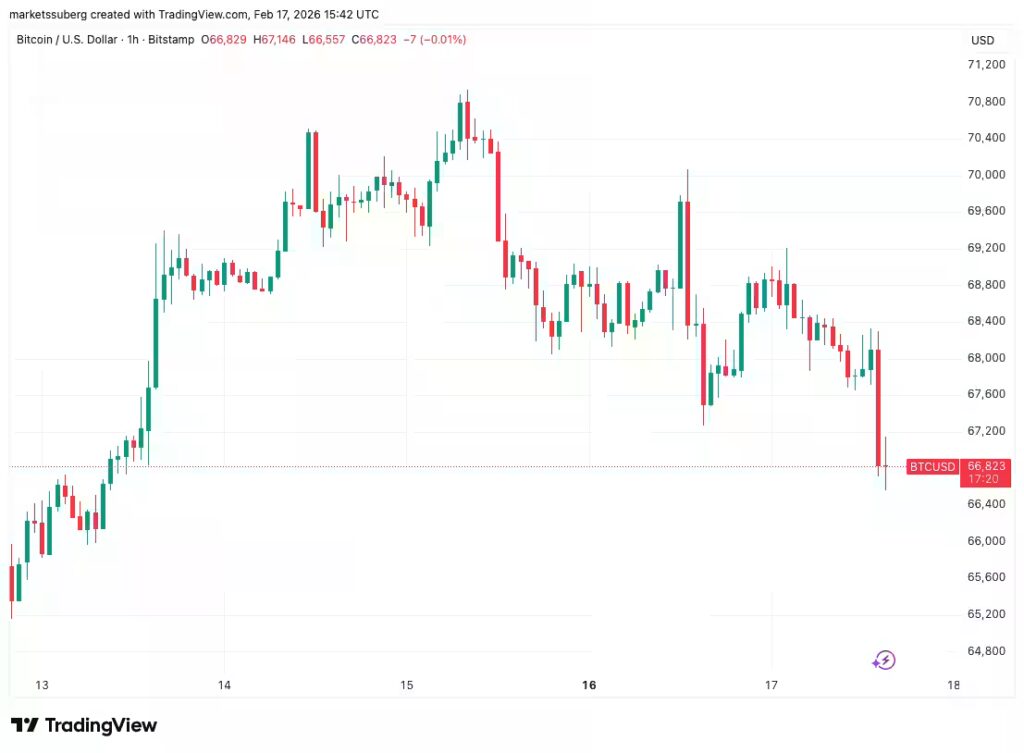
It was a jittery start to the US trading week, and Bitcoin didn’t escape the nerves.
As Wall Street opened on Tuesday, Bitcoin slipped below $67,000, dropping more than 3.8% on Bitstamp, according to data from TradingView.
The sell-off wasn’t happening in isolation.
Stocks were under pressure too, as geopolitical tension once again crept into financial markets.
Risk assets across the board took a hit, reminding traders just how sensitive sentiment can be when global flashpoints flare up.
Iran Tensions Rattle Risk Assets
The immediate catalyst? Naval drills by Iran in the Strait of Hormuz, one of the world’s most strategically important oil routes.
Any instability there tends to send ripples through energy markets — and from there into equities and crypto.
Interestingly, talks between the US and Iran had reportedly concluded around the same time, with Iranian officials describing them as “serious and constructive.”
But markets clearly weren’t in the mood to celebrate diplomacy.
The S&P 500 and the Nasdaq Composite both fell by as much as 1.25% in early trading.
Even gold, often seen as a safe haven, dipped toward $4,842 per ounce.
When both growth assets and traditional hedges wobble together, it usually signals broad uncertainty rather than a single-asset problem.
Liquidity Gets Squeezed as Bitcoin Stays Rangebound
Zooming in on Bitcoin’s structure, traders noted that the broader price range remains intact despite the drop.
According to data from CoinGlass, price action sliced through nearby bid liquidity during the sell-off, triggering liquidations along the way.
Some market watchers pointed out that large buy orders were still sitting near the $60,000 level on major exchanges.
In other words, if Bitcoin continues sliding, there’s significant liquidity waiting lower down.
That could act as a magnet — or a floor — depending on how aggressively sellers push.
Recent sessions have already been marked by so-called “liquidity games,” where both long and short traders were caught off guard by sudden moves.
For now, Bitcoin appears stuck in consolidation mode, with volatility compressing inside a defined range.
Traders are essentially waiting for the next expansion.




Strategy’s Bitcoin Buy Fails to Lift Mood
Under normal circumstances, corporate accumulation might have sparked a bounce.
Strategy — the company formerly known as MicroStrategy — added nearly 2,500 BTC over the past week. CEO Michael Saylor confirmed that the firm now holds 717,131 BTC, making it the largest corporate holder of Bitcoin in the world.
That’s no small number. Strategy’s average cost basis now sits above $76,000, meaning the company is underwater on paper at current prices.
Yet even this show of conviction failed to shift broader sentiment.
At the same time, onchain data hinted at potential outflows from US spot Bitcoin ETFs.
BlackRock was seen depositing large amounts of BTC and ETH to Coinbase Prime, sparking speculation about positioning shifts among institutional players.
The Quantum Question Resurfaces
Over the weekend, investor and Shark Tank co-host Kevin O’Leary added another layer of uncertainty.
Speaking on FOX News, he said concerns about quantum computing potentially breaking Bitcoin’s cryptographic security are still lingering among institutions.
O’Leary made it clear he remains long Bitcoin, but suggested that roughly 10% of investors are increasingly wary of quantum threats.
According to him, some institutions are capping Bitcoin exposure at just 3% of portfolios as a precaution.
To be fair, quantum computing threats to Bitcoin are widely debated.
Many experts argue that the network would likely implement upgrades long before quantum machines become powerful enough to compromise it.
Still, perception matters in markets — and even theoretical risks can weigh on sentiment.
A Market in Waiting
For now, Bitcoin seems caught between macro fear and structural support.
Geopolitical tension is driving short-term selling, while long-term believers — including corporate treasuries — continue accumulating.
But without a decisive catalyst, the market feels like it’s in a holding pattern.
Traders are watching liquidity levels, ETF flows, and global headlines closely.
One sharp move — in either direction — could break the current range and define the next phase.
What’s Next?
In the near term, all eyes will remain on developments in the Middle East, especially anything affecting oil routes or US-Iran relations.
On the crypto side, ETF flow data will be critical.
Sustained outflows could amplify downside pressure, while renewed inflows might help stabilize sentiment.
Meanwhile, corporate buying from players like Strategy could continue quietly in the background.
If Bitcoin loses the $60,000 support zone, volatility could accelerate.
On the flip side, a reclaim of the $70,000 region might restore bullish momentum and squeeze sidelined shorts.
Summary
Bitcoin fell below $67,000 as geopolitical tension linked to Iranian naval drills rattled global markets.
Stocks also declined, while liquidity conditions in crypto markets tightened.
Despite Strategy adding nearly 2,500 BTC to its holdings, sentiment remained cautious.
Concerns about ETF outflows and renewed debate over quantum computing risks added to uncertainty.
For now, Bitcoin remains rangebound, with traders watching key liquidity levels and macro headlines to determine where the next big move will come from.

