
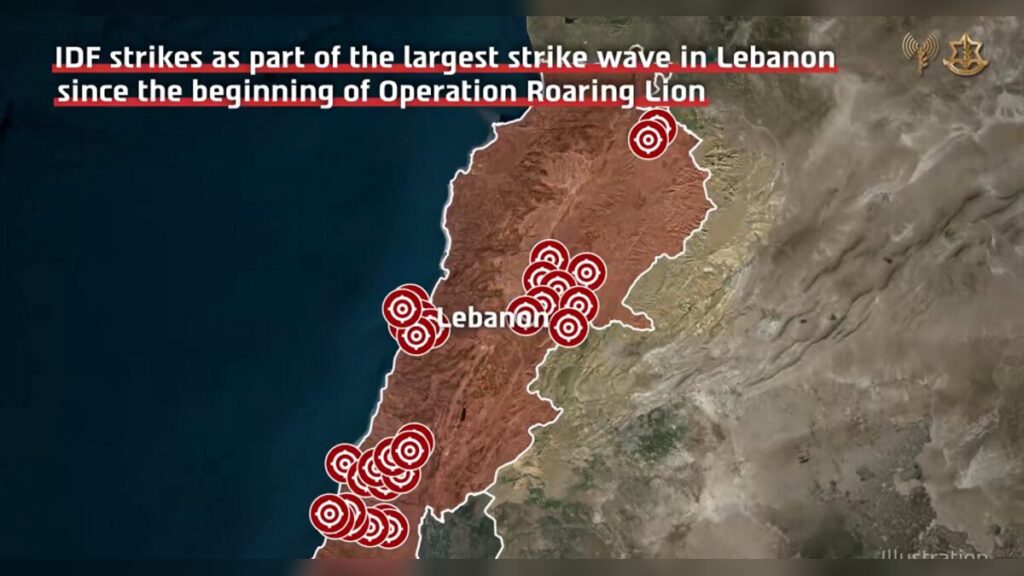
The Israel Defense Forces (IDF) say they carried out a rapid and coordinated air campaign that struck multiple Hezbollah positions across Lebanon.
According to the military, the operation unfolded within a very short timeframe, with simultaneous strikes hitting key locations in Beirut, the Beqaa region, and southern Lebanon.
Officials described the attack as intelligence-driven, emphasizing that the targets were selected based on what they called “precise and high-quality” information.
Dozens of Sites Hit at Once
In total, the IDF reported that around 100 sites were struck almost at the same time. These locations allegedly included major command centers, facilities used by Hezbollah leadership, and infrastructure linked to senior operatives.
The military claims the strikes were designed to disrupt coordination and operations by hitting multiple strategic points in one synchronized move rather than spreading attacks over time.
Heavy Casualties Reported
The IDF stated that more than 180 Hezbollah fighters were killed during the operation. The figure has not been independently verified, and there has been no immediate confirmation from Hezbollah regarding the reported losses.




If accurate, this would represent one of the most significant single-operation casualty counts in recent escalations between the two sides.
Measures to Limit Civilian Harm
Before launching the strikes, the IDF says it implemented measures aimed at reducing the risk to civilians. These reportedly included the use of precision-guided munitions and aerial surveillance to monitor conditions on the ground.
The military maintains that these precautions were intended to target only militant infrastructure while avoiding broader damage.
Impact and Consequences
This operation could mark a serious escalation in tensions between Israel and Hezbollah. A strike of this scale—both in terms of targets and reported casualties—raises the risk of retaliation and further military exchanges.
There are also concerns about the broader regional implications, especially if the situation draws in additional actors or leads to sustained conflict along the Lebanon-Israel border.
Civilian safety remains a major concern, particularly in densely populated areas like Beirut where military targets may be located close to residential zones.
What’s Next?
The immediate focus will likely be on how Hezbollah responds. Retaliatory strikes, either directly or through allied groups, remain a possibility.
International observers are also expected to monitor the situation closely, with potential calls for restraint to prevent a wider conflict. Diplomatic efforts could intensify if tensions continue to rise.
Summary
The IDF has announced a large-scale, intelligence-led airstrike targeting Hezbollah infrastructure across multiple regions in Lebanon. With over 100 sites hit and claims of more than 180 militants killed, the operation represents a significant development in the ongoing tensions between the two sides.
Bulleted Takeaways
- The IDF says it conducted simultaneous strikes across Beirut, the Beqaa, and southern Lebanon
- Around 100 targets were reportedly hit in a coordinated operation
- Over 180 Hezbollah fighters were claimed to have been killed
- Targets included command centers and infrastructure linked to senior operatives
- The IDF says precautions were taken to reduce civilian casualties
- The strike could escalate tensions and trigger retaliatory actions
- Regional stability may be affected depending on the response that follows
