
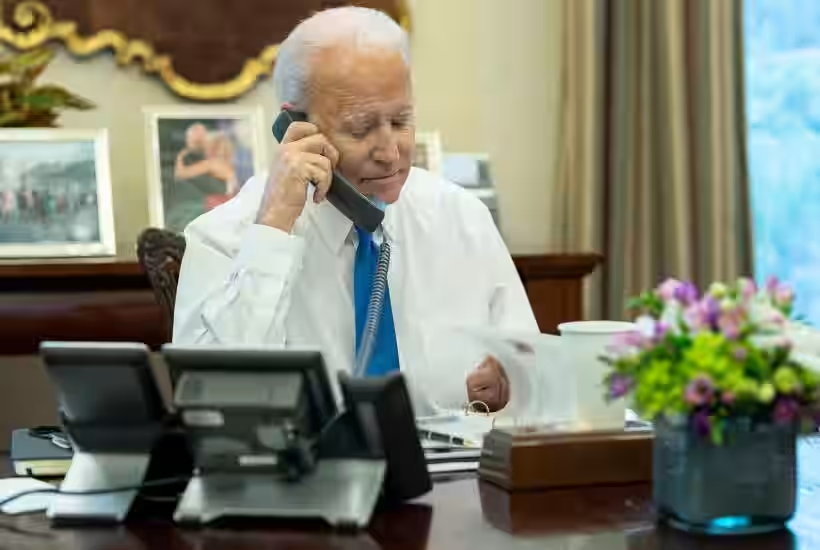
New details have emerged about a tense moment in 2021 when former Joe Biden directly called Russian President Vladimir Putin after receiving intelligence that left the White House deeply unsettled.
Reports from The Guardian indicate that American intelligence agencies had warned Biden that Putin might use his annual state-of-the-nation address to signal potential military actions concerning Ukraine.
Intelligence Assessments Spark Urgency
According to the report, US officials briefed Biden roughly a week prior to Putin’s speech.
Analysts suggested that the address could include rhetoric justifying escalatory measures, raising alarm among top American policymakers.
Former Director of National Intelligence Avril Haines recalled that Biden reacted with unusual urgency, expressing concern and even proposing a summit in the coming months to address potential risks.
The intelligence reports reportedly described possible moves by Russia that could threaten Ukraine’s security and destabilize the region, prompting the president to seek direct dialogue with Putin rather than rely solely on indirect channels.
The call was intended to clarify intentions and potentially deter aggressive steps.
Putin’s Speech Defied Predictions
Despite the anxiety fueled by these assessments, Putin’s address did not include the aggressive signals that US intelligence had feared.
Analysts noted that the speech lacked any direct justification for military escalation.




The day after the address, the Russian Defense Ministry announced the completion of inspections involving forces from the Southern and Western military districts and ordered troops back to their permanent bases.
This move was widely analyzed as a non-escalatory step, contrasting with the warnings previously circulated in Washington.
Political Reverberations Years Later
The incident has resurfaced in discussions over the Ukraine conflict, particularly after a high-profile summit on August 16, 2025, between Putin and former President Donald Trump in Anchorage.
During that meeting, Putin publicly agreed with Trump’s assertion that a different outcome in the 2020 US election might have changed the trajectory of events.
Trump has repeatedly framed the Ukraine crisis as stemming from what he calls “Biden’s failure,” while also acknowledging Russia’s objections to Ukraine’s potential NATO membership.
These statements continue to influence political narratives in the US and abroad, highlighting how intelligence reports and presidential decisions can have long-lasting implications.
What’s Next?
-
Scholars and analysts may continue to examine how US intelligence assessments shaped presidential decision-making in 2021.
-
The episode could inform future approaches to early-warning intelligence and direct diplomatic engagement with world leaders.
-
Ongoing debates about the Ukraine conflict’s origins may revisit this call as a critical example of crisis management and communication.
-
Political commentators and historians are likely to evaluate how both Biden’s and Trump’s statements influence international perceptions of US policy toward Russia.
Summary
In 2021, former President Joe Biden made a direct call to Russian President Vladimir Putin after intelligence suggested that Putin’s state-of-the-nation address might justify military action toward Ukraine.
The speech ultimately did not contain the anticipated aggressive signals, and Russian forces returned to their bases shortly afterward.
The episode has resurfaced amid ongoing debates about the Ukraine conflict, particularly following Trump’s public remarks suggesting a different 2020 election outcome could have altered events.
The call illustrates the tension between intelligence assessments, presidential decision-making, and diplomatic communication during high-stakes international situations.

