
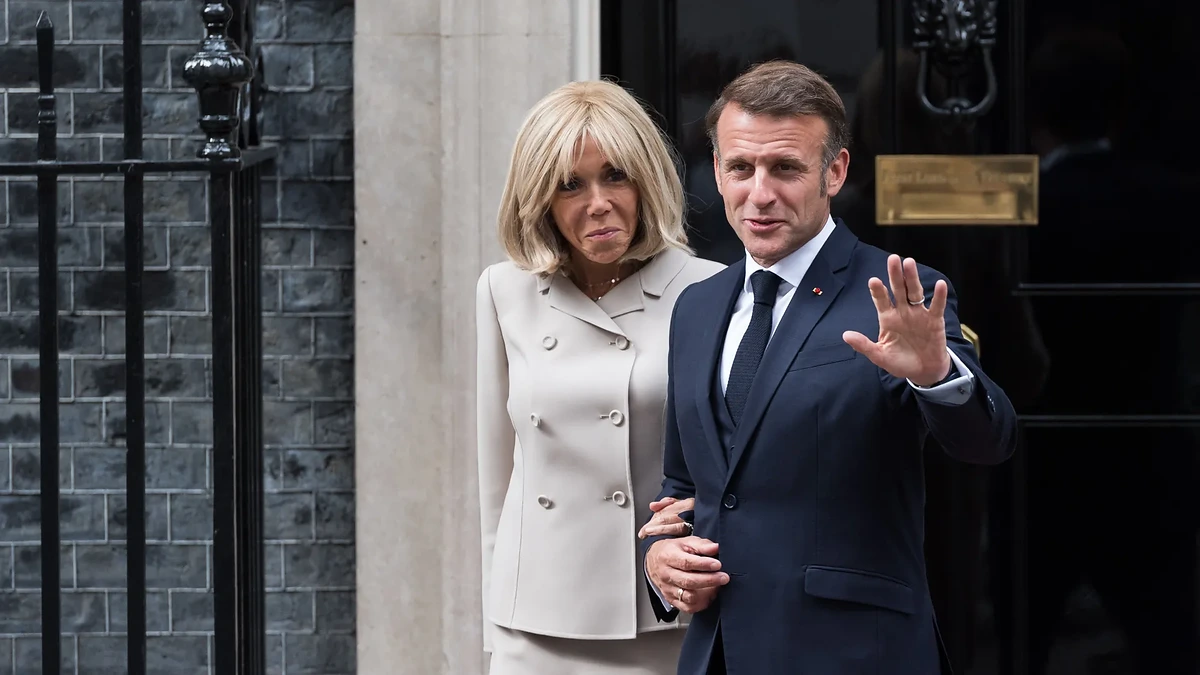
Brigitte Macron has reportedly said her husband, French President Emmanuel Macron, has never overcome the loss of his grandmother and should undergo psychoanalysis, according to a new biography examining his childhood, relationships and political career.
The comments appear in Ce pays dont le prince est un enfant (This Country Whose Prince is a Child), written by veteran French political journalist Catherine Nay.
The biography draws on conversations with the presidential couple and people who knew Macron during his childhood.
The book portrays the 48-year-old president as an exceptionally gifted but emotionally immature individual who struggles with criticism and has difficulty maintaining relationships with people who challenge his decisions.
Brigitte Macron Says Her Husband Has Never Replaced His Grandmother
In the biography, Nay quotes Brigitte Macron, 73, as describing her husband’s enduring attachment to his grandmother, Manette.
“Emmanuel still hasn’t buried his grandmother. He hasn’t even replaced her.
He ought to be psychoanalysed,” Brigitte reportedly told the journalist.
Macron also acknowledged his continuing emotional connection to his grandmother, telling Nay: “I still live in my grandmother’s spirit.”
According to the biography, Manette played a dominant role in shaping his childhood.
A retired headmistress, she was determined to develop her favourite grandson into what she considered her personal masterpiece.
She encouraged his intellectual development through an environment centred on books, literature and classical French texts, regularly training him to recite passages aloud.
Manette also supported his ambition to become a celebrated writer.
However, Macron eventually abandoned the dream after failing to find a publisher for his novel.
Nay describes his grandmother as his first political mentor, although her influence extended into his personal life.
Grandmother’s Influence Strained His Relationship With His Parents
The biography suggests Macron’s exceptionally close relationship with Manette created distance between him and his immediate family.
His mother, Françoise Noguès, reportedly felt increasingly excluded from her son’s life as his attachment to his grandmother deepened.
Recalling their relationship, Noguès told Nay that Manette constantly embraced Emmanuel and told him, “I only love you, I only love you.”
She added that her mother had never expressed the same affection towards her.
“Emmanuel knows my mother’s life much better than I do. They talked a lot.
Mother never spoke to me about her,” she reportedly said.
Macron’s father, Jean-Michel, also expressed concern about the arrangement, once telling his wife: “You gave our son to your mother.”
The book further recounts how Manette reacted when Emmanuel began dating a girl at the age of 14.
She reportedly became furious, threw his belongings outside and ordered him to return to his parents.
The teenager eventually returned after promising: “I won’t look at girls any more.”
Macron’s Teenage Relationship With Brigitte
Nay also examines Macron’s relationship with Brigitte, who was his teacher before becoming his wife.
According to the journalist, the future president was already demonstrating unusual confidence and an ability to charm influential adults during his teenage years.
He reportedly showed little interest in friendships with other children and preferred engaging with his teachers, often challenging them with difficult questions.
Nay told Europe 1 radio that he frequently flirted with his teachers and was particularly skilled at attracting the attention of influential people.




The biography suggests Macron actively pursued opportunities to spend time with Brigitte, who was married and had three children at the time.
One such opportunity reportedly came when he suggested that they work together on a play.
Brigitte later recalled asking the teenager whether he wanted children of his own.
According to the account, he replied: “No, I want you to look after only me.”
Nay describes their relationship as an instance of an adolescent pursuing an adult rather than the reverse.
Brigitte also recalled being impressed by his confidence when they first met.
“I had never met anyone so strong,” she reportedly told the journalist, describing him as “a raw diamond”.
She added that, when he was 20, he made her feel “protected from everything”.
Biography Describes Macron as Unable to Accept Criticism
The journalist argues that Macron’s childhood experiences contributed to his difficulties in developing ordinary relationships with people his own age.
According to Nay, he missed out on the friendships, disagreements and compromises that help teenagers learn how to navigate relationships with their peers.
Instead, he became accustomed to winning over influential individuals who could help advance his ambitions.
However, several people who supported him before his political rise reportedly felt abandoned after he became president.
French businessman Xavier Fontanet, who exchanged messages with Macron for years, told Nay that their communication stopped after his election.
“When he was elected, he never replied to my messages again,” Fontanet said.
Gilles Finchelstein, director of the left-wing Jean-Jaurès Foundation, also described a breakdown in their relationship after he offered Macron advice about his presidential ambitions.
Finchelstein recalled warning him that he was not ready for the presidency because he lacked knowledge of certain subjects and did not sufficiently understand the country.
“He didn’t like what I said. I never saw him again,” he told Nay.
The biography suggests Brigitte is among the few people permitted to openly challenge her husband’s views.
Snap Election Decision Changed Brigitte’s Perception of Her Husband
Nay identifies Macron’s inability to question his own judgement as one of his greatest weaknesses.
His confidence helped him become France’s youngest president since Napoleon at the age of 39, but the journalist argues that it has developed into an unwillingness to accept that he could be wrong.
She points to his decision to call snap parliamentary elections in 2024 as an example.
The gamble left his political camp without a parliamentary majority and plunged France into political uncertainty.
Brigitte reportedly acknowledged that her perception of her husband’s ability to protect and support her had changed following the election.
“I felt much more protected by him then than I do today,” she said, referring to the period before the political setback.
Nay also told France Inter radio that Macron struggles with self-reflection.
“Introspection doesn’t enter his intellectual world,” she said.
She added that even when he apologises, he later returns to explain why he believes his original position was correct.
Macron Admitted He Never Experienced a Normal Teenage Life
The biography includes comments in which Macron reflects on his childhood and his relationship with young people.
“Me, I’m still a child,” he reportedly told Nay.
The journalist also referenced an interview he gave writer Emmanuel Carrère in 2025, during which he said: “I have never been a teenager.
I don’t like teenagers. I don’t understand them. My wife does.”
Nay argues that his unusual upbringing and early relationship with Brigitte contributed to his separation from ordinary social experiences.
She also suggests that his growing isolation has continued throughout his presidency, leaving him increasingly detached from the everyday experiences of French citizens.
Macron’s Political Future and Final Months in Office
The biography examines Macron’s political difficulties as he approaches the end of his second and final presidential term in May.
His political centre has weakened, while the nationalist Right and radical Left have strengthened their positions.
Nay also recalls that Macron barely campaigned for re-election in 2022.
When asked why, he reportedly admitted: “Because I was exhausted.”
According to the journalist, Brigitte had not wanted him to pursue a second term.
The book’s title draws inspiration from Henri de Montherlant’s 1951 play La Ville dont le prince est un enfant (The City Whose Prince is a Child), which explores a schoolboy’s influence over adults.
Nay also compares Macron with Julien Sorel, the ambitious central character in Stendhal’s novel Le Rouge et le Noir, one of the president’s favourite books.
Sorel rises from humble beginnings but ultimately meets a tragic end at the guillotine.
Reflecting on Macron’s decision to dissolve parliament and call the 2024 snap election, Nay wrote: “By dissolving parliament, he guillotined himself.”
