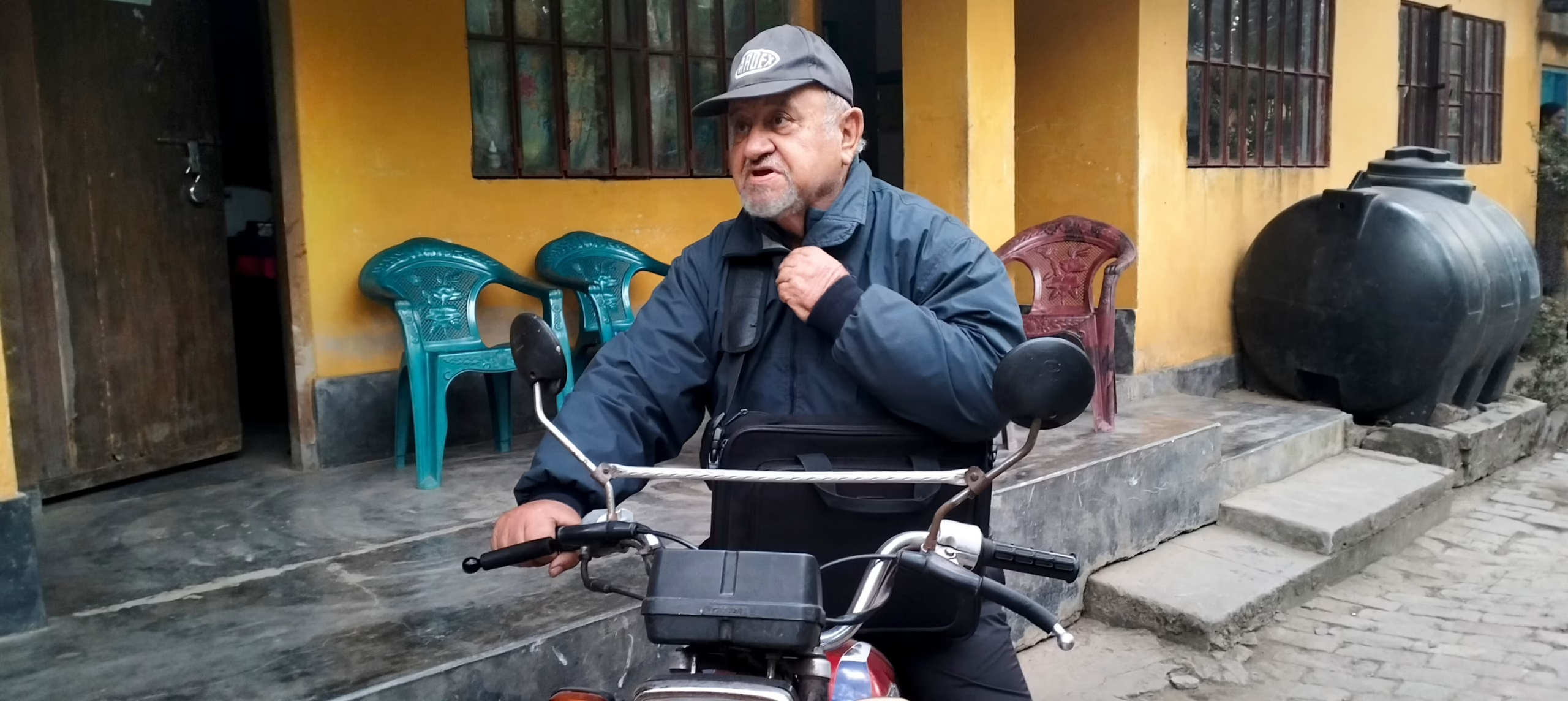

For over 50 years, Father Luigi Paggi, a 77-year-old Italian missionary, has dedicated his life to one mission: protecting the most vulnerable in Bangladesh from a practice that has stolen countless childhoods—child marriage.
Living among the Munda Indigenous community in coastal Bangladesh, Paggi has built schools, mentored girls, and waged what he calls a quiet war against early marriage. His core message is simple but radical:
“Disobedience is life.”
Early Life and Arrival in Bangladesh
Born on July 26, 1948, in the small Italian village of Sorico near the Switzerland border, Luigi Paggi joined the diocesan seminary in Como after primary school. He spent six years there before entering the Xaverian Missionaries, continuing his studies and ultimately being ordained a priest in 1972.
Three years later, in 1975, he arrived in Bangladesh. Initially, he served as an assistant pastor in Satkhira, gaining firsthand insight into the struggles faced by marginalized communities.
Educating the Marginalized
From 1980 to the early 2000s, Paggi worked among the lower-caste Rishi Hindu community—cobblers and sweepers often denied access to education and civil rights.
“I helped them discover their dignity and study the teachings of Dr. Bhim Rao Ambedkar,” Paggi recalled. “Many became his disciples and started peaceful protests to claim their place in society.”




Some members of the Rishi community eventually converted to Christianity, forming a subcenter of the Khulna Diocese.
Turning Attention to the Munda People
In 2002, Paggi shifted focus to the Munda, a small Indigenous community living on the fringes of the Sundarbans mangrove forest. What he found shocked him: there were far fewer women than men, a gap caused largely by girls dying from complications of early motherhood.
Determined to act, he embarked on a campaign to prevent child marriages. Traveling on his motorcycle along narrow, brick-paved coastal roads, Paggi visited village after village, teaching girls about the dangers of early marriage.
Education as Resistance
Paggi didn’t stop at awareness. He built a hostel for 20–30 boys and girls, established pre-primary schools, and promoted education as the ultimate tool against oppression. His guiding principle, “Disobedience is life,” became the rallying cry for girls resisting forced marriages.
Over the years, the campaign yielded results. Girls were saved from early marriage, educated, and empowered. Some now work as teachers, in private institutions, or with NGOs, shaping the next generation.
A Success Story: Minati Munda
One of Paggi’s students, Minati Munda, now 30, credits the priest with giving her a second chance at life. Fleeing her family’s plans to marry her off, she found refuge in Paggi’s hostel.
“Father Luigi gave me a second life,” she said. “I left home, studied at the hostel, and eventually earned a bachelor’s degree in civil technology. Now I teach at a Caritas Bangladesh Trust technical institution.”
Minati also helped other girls avoid child marriage, eventually becoming the first Christian in her area through baptism administered by Paggi.
A Lifetime of Sacrifice
Paggi admits the work is far from over. Decades of effort have brought slow but steady change, but traditions die hard. Now, after years of traveling rugged roads, Paggi’s health has declined, limiting his mobility.
Despite this, his commitment remains unwavering. “Much more time is needed,” he says. And even after decades abroad, he dreams of returning home to Italy:
“My wish is to return to my country, die in my paternal house, and be buried in my native village.”
Legacy of Hope
Father Luigi Paggi’s life is a testament to dedication, courage, and the power of education. Through his work with the Munda and Rishi communities, he has challenged harmful traditions, saved countless young lives, and shown that sometimes, survival depends on a simple act: saying no when your life is at stake.