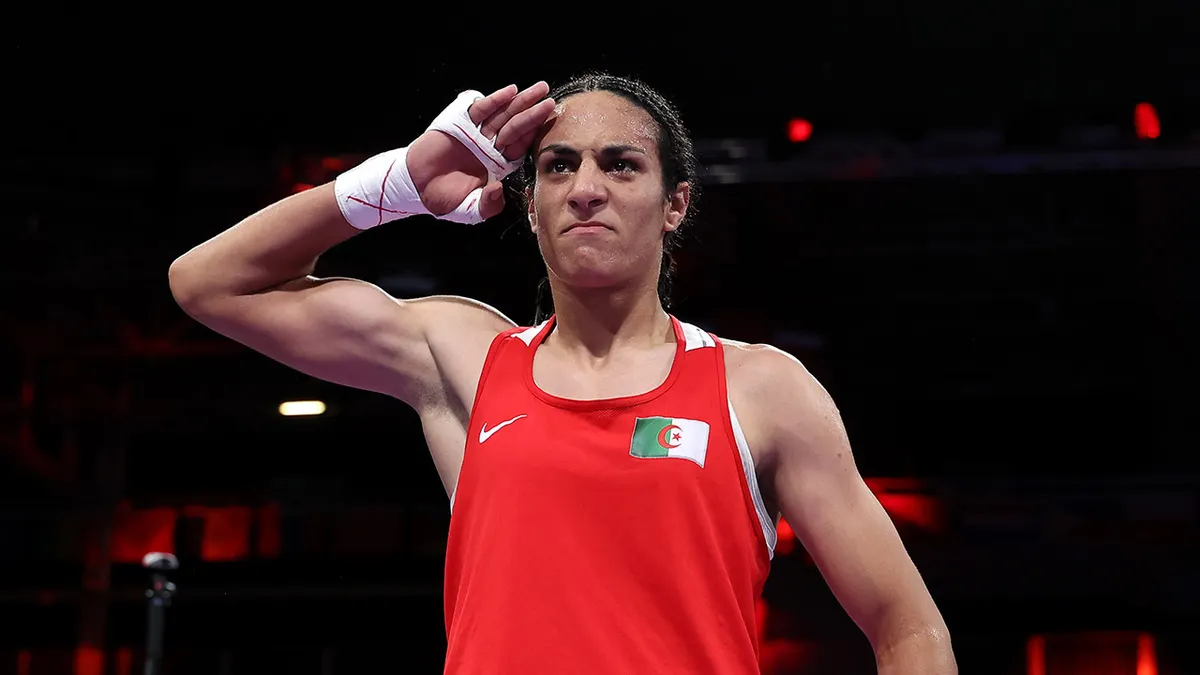

Olympic boxing champion Imane Khelif has found herself at the center of a heated debate, responding boldly to criticism from none other than U.S. President Donald Trump.
The 26-year-old Algerian athlete, who made history by winning gold at the 2024 Paris Olympics, is now setting her sights on the 2028 Los Angeles Games and is prepared to undergo a sex verification test to prove her eligibility.
“I’m a girl, not trans, and I want my medal,” Khelif told the media, emphasizing her determination to continue competing despite the controversies surrounding her.
Rising to Fame Amid Scrutiny
Khelif first caught global attention after her stunning Olympic victory, but her achievement also sparked a wave of debate.
Critics claimed she might not meet gender eligibility rules, pointing to prior tests.
In response, World Boxing introduced mandatory sex screening for competitors in 2025 and cited Khelif specifically, though they later apologized for the way the announcement singled her out.
Since the new rules were introduced, Khelif has not returned to competition.
She has taken her case to the Court of Arbitration for Sport (CAS), challenging the requirement to undergo testing, though a hearing has yet to be scheduled.
Standing Firm While Preparing for Los Angeles
Despite the ongoing legal battle, Khelif says she is ready to take whatever steps are necessary to compete in the Olympics.
“Of course, I would accept doing anything I’m required to do to participate in competitions,” she told CNN.
“They should protect women, but they need to make sure that in doing so, they’re not harming other women.”
Her commitment shows that even under intense scrutiny, Khelif is focused on her training and the next chapter of her athletic career.



Donald Trump’s Controversial Comments
Former President Trump has repeatedly referred to Khelif as a “male boxer” who allegedly “stole” the women’s gold medal in Paris.
Last year, he signed an executive order titled Keeping Men Out of Women’s Sports, singling her out again during speeches to Republican lawmakers.
Khelif has been clear in response, explaining that she was born female and is not transgender.
“I didn’t ask for any of this,” she told French outlet L’Equipe.
“I respect everyone, including Trump because he’s the president of the United States, but he cannot distort the truth. I’m not trans, I’m a girl.
I was raised as a girl, grew up as a girl, and everyone in my village knows me as a girl.”
The Future of Gender Rules in Olympic Sports
The Paris controversy has sparked broader discussions about gender eligibility in sports.
A ban on transgender women competitors is expected for the 2028 Olympics, though rules for athletes with differences of sexual development (DSD) remain uncertain.
Currently, each sport sets its own testosterone threshold for eligibility, but the International Olympic Committee, now under Kirsty Coventry, is reportedly considering a sweeping policy change that could impose a blanket ban across all sports in Los Angeles.
Khelif remains unshaken by the policy debates.
She jokes about her training efforts, saying, “I’m working so hard that maybe Mr. Trump himself will come and put the medal around my neck in Los Angeles.”
A Personal Battle Off the Ring
The scrutiny following her gold medal win was intense, even prompting her mother to suggest she quit boxing.
“The attacks were so vicious,” Khelif recalls.
“My mother told me it was too hard to take. I thought about stopping too. But when I look at my medal, all those doubts disappear.
For three months after the Games, I looked at it every day. It reminded me of the sacrifices I made and the emotions I poured into reaching this moment.”
Her story reflects not just a fight inside the ring, but also resilience in the face of public controversy, politics, and personal challenges.
Eyes on Los Angeles
Looking ahead to 2028, Khelif remains resolute.
She is ready to prove herself once again on the world stage, confident in her identity, and committed to her sport.
“I’m a girl, a young Arab Muslim woman, and a boxer,” she says.
“I’m training, and I want to compete—fairly, proudly, and strongly.”
