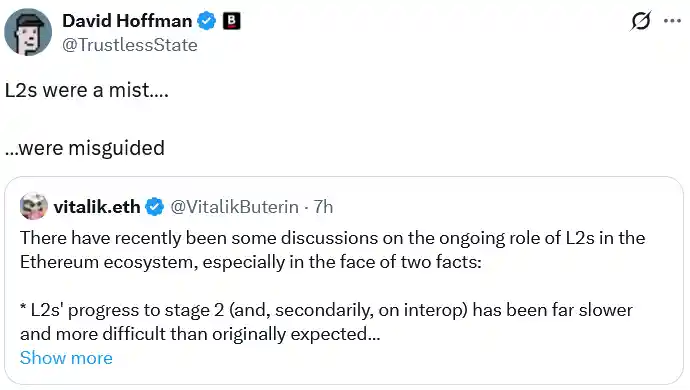

Ethereum co-founder Vitalik Buterin has shaken up the crypto world by reversing a long-held belief about layer-2 scaling.
Once a major advocate of offloading transactions to layer-2 networks, he now says that approach “no longer makes sense” and that Ethereum needs a fresh direction.
Rethinking the Role of Layer-2s
Layer-2 solutions, including Arbitrum, Optimism, Base, and Starknet, were originally designed as extensions of Ethereum.
The idea was simple: move most transactions off the main chain to increase speed and cut costs, all while maintaining Ethereum’s security.
But Buterin argues that many layer-2s have missed the mark.
“If you create a 10,000 TPS EVM where its connection to L1 is mediated by a multisig bridge, then you are not scaling Ethereum,” he explained in a post on X.
In his view, layer-2s have often failed to achieve true decentralization, undermining the vision of fully secured Ethereum scaling.
A Pivot Toward Specialized Use Cases
Rather than focusing on raw scalability, Buterin suggests layer-2s should pivot to niche applications.




Areas like privacy, identity, finance, social networks, and AI are potential directions where layer-2s could provide value without attempting to replicate the mainnet’s security model.
This represents a major shift in Ethereum’s technical roadmap, which for years positioned layer-2s as the central scaling solution for the network.
Some Ethereum developers have long argued for increased scaling on the mainnet itself, including Max Resnick, who moved to Solana after his push for mainnet-first scaling failed to gain traction.
Native Rollups and Gas Limits Take Center Stage
Buterin is increasingly confident that native rollups, built directly into Ethereum, will play a pivotal role in scaling.
Unlike traditional rollups that bundle transactions off-chain, native rollups are processed and verified by Ethereum validators themselves.
The integration of zero-knowledge Ethereum Virtual Machine (zkEVM) proofs is expected to further enhance this approach.
In addition, Ethereum developers recently implemented a gas limit increase from 60 million to 80 million following a hard fork in January.
This change allows more transactions and smart contract operations per block, boosting throughput and potentially lowering fees for users.
A Long-Term Vision for Ethereum’s Mainnet
Ethereum researcher Justin Drake outlined a 10-year plan last July aiming for 10,000 transactions per second on the mainnet once all scaling features, including native rollups and other improvements, are in place.
Currently, Ethereum handles just 15–30 TPS, meaning the network has room to grow substantially.
Community Reactions
The pivot has received support from notable figures in the Ethereum community.
Ryan Sean Adams, co-host of Bankless, called it “the pivot” and welcomed the acknowledgment that strengthening Ethereum’s base layer is critical.
The Path Ahead
With layer-2s refocusing on specialized applications and native rollups and gas limit increases driving mainnet scaling, Ethereum appears to be entering a new phase.
The network is seeking not just faster transactions but a smarter, more secure path to growth — one that combines innovation with the strength of its foundational layer.
