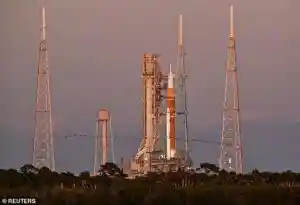

NASA’s decision to postpone its first crewed moon mission in nearly 50 years was supposed to be a technical footnote.
Instead, it reopened a floodgate of old rumors, new suspicions, and a resurfaced claim that astronauts may have encountered something unexpected on the moon back in 1969.
What began as an engineering issue quickly morphed into online chatter questioning not just the Artemis II mission, but the very history of lunar exploration itself.
A Podcast Claim Revives a Long-Running Lunar Legend
The latest spark came from AJ Gentile, host of the conspiracy-focused podcast The Why Files.
During an appearance on The Tucker Carlson Show, Gentile revisited a decades-old story that has never quite disappeared: the idea that Apollo 11 astronauts Neil Armstrong and Buzz Aldrin spotted non-human beings on the moon.
According to the tale, the astronauts briefly switched to a private medical radio channel during a communications blackout as they approached the lunar surface.
The Alleged “Lost Transmission” From Apollo 11
Gentile claimed that during that short radio silence, Armstrong and Aldrin allegedly told mission control they could see figures “parked” inside a nearby crater, apparently watching their arrival.
The story suggests these beings were close enough to be observed clearly and aware of the astronauts’ presence.
Gentile summed up the legend bluntly: the astronauts supposedly said, “They’re here.
They’re on the crater, and they can see us.”
Why the Story Never Quite Goes Away
Despite being repeated for more than half a century, there has never been proof that Apollo 11 used a backup medical channel during the landing, let alone that such a conversation occurred.
NASA’s records don’t support the claim, and no recordings have ever surfaced.
Still, the story lingers, partly because of how little margin for error—or explanation—people believe existed during the earliest days of spaceflight.
Official Denials Versus Persistent Doubt
The U.S. government and the Pentagon have consistently said no physical evidence of UFOs or extraterrestrial life has ever been recovered.
Yet Gentile argued that those denials haven’t stopped former intelligence insiders and astronauts from hinting that something unusual exists beyond Earth.
According to him, whatever was encountered on or near the moon was quietly buried once lunar missions ended in the early 1970s.
When the CIA Looked to the Mind for Answers
Fueling those suspicions are declassified CIA programs from the 1970s and 1980s that explored “remote viewing”—the idea that certain individuals could mentally perceive distant locations.
Gentile pointed to Ingo Swann, one of the most famous figures tied to those experiments.




Swann reportedly claimed that during a psychic session in 1975, he observed structures, towers, and humanoid beings working on the moon’s far side.
Ingo Swann’s Chilling Lunar Vision
Swann later detailed those experiences in his 1998 book Penetration: The Question of Extraterrestrial and Human Telepathy.
Perhaps the eeriest part of his account was his insistence that the beings he “saw” were aware of him in return.
He claimed two of them pointed directly toward his location on Earth, leading him to wonder whether they possessed psychic abilities of their own.
Swann died in 2013, but his claims continue to circulate in UFO lore.
Astronauts Who Took UFOs Seriously
Gentile also cited Apollo 14 astronaut Edgar Mitchell, who openly said he believed UFOs were real and that extraterrestrials had visited Earth.
Mitchell argued that governments were hiding what they knew.
Gentile emphasized that Mitchell wasn’t a fringe figure, but the sixth human to walk on the moon.
To him, that credibility alone suggested there was more to the story than fantasy.
Moon Landing: Real, But Still Uncomfortable
When asked whether he believed the original moon landing was staged, Gentile said no—he believes Apollo 11 really happened.
Still, he admitted the topic makes him uneasy, pointing to missing or incomplete records from that era.
For conspiracy-minded observers, those gaps are proof of a cover-up; for historians, they’re often chalked up to outdated storage and documentation practices.
Online Skeptics Pile On as Artemis Slips
As NASA confirmed delays to Artemis II, social media critics were quick to pounce.
Some argued that if modern technology struggles to reach the moon, then the achievements of the 1960s must have been staged.
Others mocked NASA’s pace compared to private companies like SpaceX, claiming the delay only reinforces doubts about whether humans ever left Earth orbit at all.
What Actually Went Wrong With Artemis II
NASA’s explanation is far less dramatic.
The agency initially planned to send four astronauts on a 10-day mission looping around the moon and back as early as February 6.
Extreme winter weather pushed that date to February 8, before a fuel leak was detected during testing on Monday.
Engineers halted the countdown when liquid hydrogen levels spiked unexpectedly.
Inside the Wet Dress Rehearsal
The issue occurred during a “wet dress rehearsal,” a critical test where the Artemis II rocket is filled with more than 700,000 gallons of super-chilled liquid hydrogen and oxygen.
These propellants are essential for liftoff, but also notoriously difficult to manage.
NASA says stopping the test early was the safest option while engineers assess the leak.
The New Launch Windows on the Table
For now, NASA is targeting early March, with potential launch dates set for March 6, 7, 8, 9, or 11.
If further problems arise, backup opportunities are reserved for the first week of April.
Whether or not the delay quiets the rumors—or adds fuel to them—remains to be seen.
What Comes Next
As Artemis II waits on the launch pad, the technical work continues behind the scenes.
Meanwhile, old stories about moonwatching beings, lost radio channels, and psychic spies are once again circling the internet.
For NASA, it’s another reminder that reaching the moon isn’t just an engineering challenge—it’s a cultural one too.
