
If you thought the rivalry between prediction market platforms was all spreadsheets and trading dashboards, think again.
This week in New York City, the competition spilled onto the sidewalks — in the form of free groceries.
Two of the biggest names in the space, Kalshi and Polymarket, are now fighting for attention by filling shopping bags instead of pushing ads.
Kalshi Turns a Manhattan Market Into a Giveaway Hub
On Tuesday afternoon, Kalshi transformed the Westside Market on 3rd Avenue into a magnet for hungry New Yorkers.
Between noon and 3 p.m., the company handed out $50 worth of groceries to anyone lucky enough to get in line. And the turnout was massive.
Social media clips showed queues wrapping around multiple city blocks.
Kalshi later said nearly 1,800 people officially signed up for the giveaway, while news outlets described crowds in the thousands.
The company even hinted that its move may have sparked similar ideas across other businesses watching closely.
The Numbers Behind the Niceness
This generosity isn’t coming from startups scraping by.
Prediction markets have exploded over the past year, and Kalshi and Polymarket sit firmly at the top of the pile.
Daily trading volumes across these platforms now regularly clear $400 million — roughly four times higher than where things stood a year ago.
Kalshi alone pulled in about $263.5 million in fee revenue in 2025.




Both companies are now valued in the billions, boosted by high-profile integrations and a surge of mainstream attention.
Polymarket Raises the Stakes With a Free Store
Not to be outdone, Polymarket unveiled an even bolder plan.
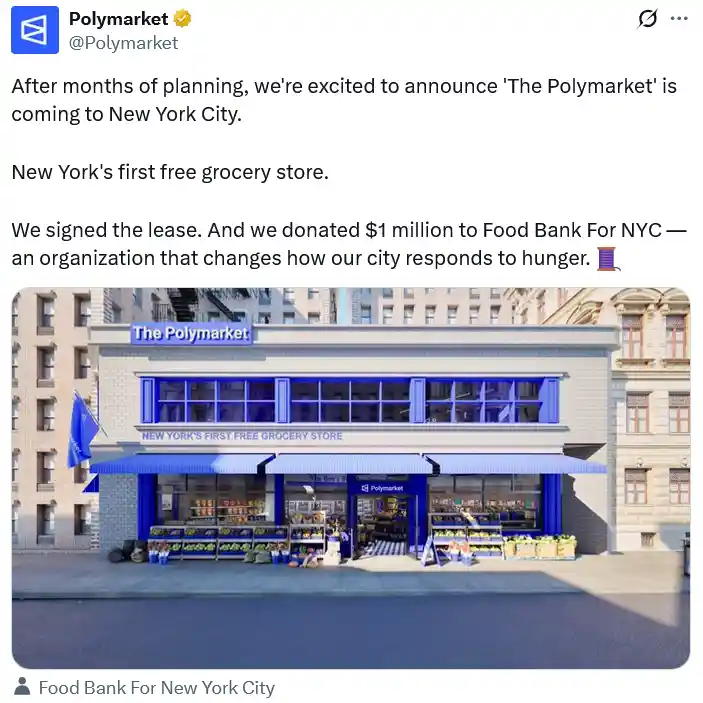
The company announced it has signed a lease for what it calls “New York’s first free grocery store.”
The shop, simply named “The Polymarket,” is set to open next Thursday at noon.
Beyond the storefront, Polymarket also pledged $1 million to Food Bank for NYC, aiming to support residents across all five boroughs who struggle with food access.
According to the company, the idea has been quietly in development for months and will launch fully stocked from day one.
Branding, But Make It Personal
Both firms have leaned heavily into unconventional marketing lately.
Polymarket recently partnered with Dow Jones and rolled out billboards intentionally designed to be vandalized — a tongue-in-cheek nod to public opinion.
Kalshi, meanwhile, has been lighting up digital billboards with real-time odds on trending topics, often turning city streets into live data feeds.
With prediction markets barred from advertising during the upcoming Super Bowl on February 8, these real-world stunts may be filling a crucial visibility gap.
Why It’s All Happening in New York
There’s no accident in the location.
Kalshi and Polymarket are both headquartered in New York City, and the grocery initiatives are unfolding right in their backyard.
As the home of Wall Street, the New York Stock Exchange, and Nasdaq, the city remains the global symbol of finance — and increasingly, of financial experimentation.
By taking their rivalry directly to New Yorkers, both companies are signaling that this fight isn’t just about market share.
It’s about visibility, loyalty, and showing who really understands the people powering the city.
What This Signals for the Future
Free groceries might look like a feel-good stunt, but beneath it is a serious message: prediction markets are no longer niche tools for insiders.
They’re fast becoming mainstream platforms with the money, ambition, and cultural confidence to play big.
If this is what competition looks like now, don’t be surprised if the next phase of the prediction market wars shows up somewhere unexpected — maybe not on a screen, but right in your neighborhood.
