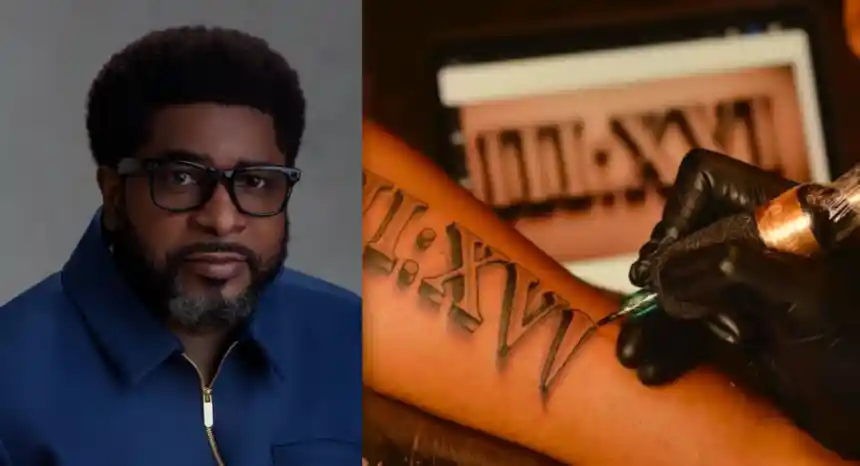

Nigerian gospel singer Mike Abdul has added his voice to the ongoing debate about tattoos in Christian circles, insisting that ink on the body does not “dishonour” the temple of God.
Speaking directly to his followers on Instagram, Abdul argued that God values inner transformation far more than unmarked skin.
Tattoos as Identity and Memory
In a post shared on Monday, Abdul reflected on the historical significance of tattoos across cultures.
He described them as tools for identity, memory, status, covenant, and storytelling, rather than acts of rebellion or sin. “Tattoos don’t dishonour the body.
What dishonours a temple is not writing on the walls; what matters is what the mark points to, not the mark itself,” he wrote.
He continued, “God reads hearts, not skin.
Ink without conviction is decoration. Ink with conviction is remembrance.
If a tattoo leads you closer to gratitude, identity, or reverence, it has served a good purpose for you.
Faith is not proven by unmarked skin, but by transformed lives.”
Responding to Scripture-Based Criticism
Critics often cite Leviticus 19:28 to argue against tattoos.
Abdul addressed this in a follow-up post, pointing out that if Christians were bound by that law, they would also need to follow other Old Testament rules, such as hair rituals, dietary laws, and clothing restrictions.




He referenced New Testament teachings, reminding followers: “‘You are not under the law, but under grace — Romans 6:14’ and ‘Let no one judge you… with regard to food or drink or a religious festival – Colossians 2:16.’”
His point was clear: the era of grace supersedes the literal enforcement of certain Old Testament codes.
Tattoos and Circumcision: A Biblical Parallel
Abdul drew an interesting parallel between tattoos and circumcision, highlighting that both are permanent marks on the body that signify identity and covenant.
“Circumcision is not a tattoo in form, but it functions like one in meaning.
Both are visible reminders of covenant, more about what they signify than the act itself,” he explained.
He added, “Circumcision was given as a physical sign of covenant.
It was a mark on the body, but its power was never in the flesh itself.
Scripture itself teaches that external marks without inward obedience are insufficient.”
Quoting Romans 2:25 and 2:29, Abdul concluded that “God prioritizes meaning, obedience, and transformation.
The debate was never Mark vs no Mark. It has always been Heart vs Hypocrisy.”
The Kingsley Okonkwo Tattoo Controversy
Abdul’s remarks follow the social media buzz sparked by Pastor Kingsley Okonkwo of the David Christian Centre, who recently got a Bible-inspired tattoo on his arm.
Posting a video of the process on Instagram, Okonkwo revealed his “III: XVI” tattoo, referencing John 3:16, a central scripture in Christian faith.
He explained that the tattoo was meant as a tool for evangelism.
“While my religious brothers and sisters were busy judging over tattoo, they didn’t notice that the gospel (John 3:16) was preached to millions in 24 hours by almost all blogs,” he said.
Challenging Judgment and Encouraging Reflection
Addressing critics further, Okonkwo reminded viewers that “there’s no scripture that says a child of God cannot have tattoos,” pointing out the lack of a concrete biblical reason for condemning body art.
Both he and Abdul emphasize that tattoos, when meaningful, can serve as personal reminders of faith, identity, and gratitude.
What’s Next
The conversation surrounding tattoos in Nigerian Christian communities continues to grow, with influential voices like Mike Abdul and Pastor Kingsley Okonkwo challenging traditional perspectives.
Their message is clear: it is the heart, not the skin, that truly matters.
