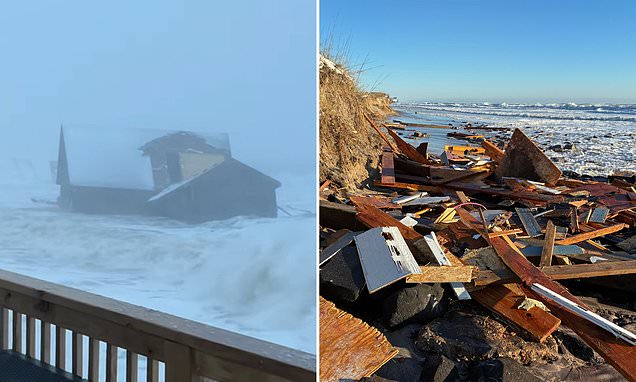

Winter’s wrath hit North Carolina’s Outer Banks this past weekend, leaving a trail of destruction as four beachfront homes tumbled into the Atlantic.
The storm, packing hurricane-force winds, massive waves, and rare snowfall, proved too much for the vulnerable barrier islands.
Fortunately, the homes were unoccupied, preventing injuries, but the scale of property loss is staggering.
Dramatic Scenes Captured on Video
In the village of Buxton, witnesses watched in disbelief as one home slowly buckled on its stilts before sliding into the churning ocean.
A bystander’s video captured the full collapse, showing waves tearing through the structure with relentless force.
Meanwhile, the National Park Service documented the aftermath with photos of debris strewn across the beach—twisted lumber, insulation, and household items littering the shoreline.
Outer Banks Facing Accelerated Erosion
The Outer Banks’ narrow, low-lying barrier islands have long battled erosion, but rising seas and increasingly violent storms are accelerating the destruction.
Since 2020, more than 30 homes along Hatteras Island have been claimed by the ocean, with many falling during extreme weather events.
Prior to this recent storm, two dozen houses built on stilts at the water’s edge had already collapsed.
Nor’easter and Bomb Cyclone Compound Damage
The latest disaster followed a powerful nor’easter fueled by a bomb cyclone, bringing blizzard-like conditions to the Carolinas and Virginia.




Gusts exceeding 60 mph, record-high tides, and towering waves battered the already fragile islands, leading to more collapses in areas like Tower Circle Road in Buxton.
The homes affected were privately owned and unoccupied, though the destruction underscores the growing vulnerability of the coastline.
A History of Loss
Buxton has seen similar devastation in recent months.
Just three months ago, five homes were wiped out in a single stretch of violent surf.
Over the years, relentless beach erosion has pushed many houses—once set safely back from the shoreline—directly into the path of the ocean.
The census paints a stark picture: Rodanthe, a community of barely one square mile, had 718 homes but only 213 year-round residents in 2020.
Buxton, slightly larger, reported 972 homes for a population of 1,181.
Cleanup Challenges Ahead
Bill King, president of the North Carolina Beach Buggy Association, explained the hazards of the debris: “It’s not just boards and nails.
You’ve got fiberglass insulation, fuel, septic systems—everything moving in the surf. It’s a nightmare.”
Cape Hatteras National Seashore has closed the Buxton beaches while assessing the damage.
A spokesman warned that debris fields stretch for miles and that remaining structures are at risk.
“Surf conditions are still elevated, and debris continues to drift southward, washing up in various areas.
It will take time to fully evaluate the extent and plan the cleanup,” the statement read.
What Lies Ahead
With climate change intensifying storms and sea-level rise eroding the coastline, the Outer Banks face an uncertain future.
For residents and local authorities, the challenge is clear: mitigating the risk, coordinating cleanups, and preparing for the next inevitable storm.
