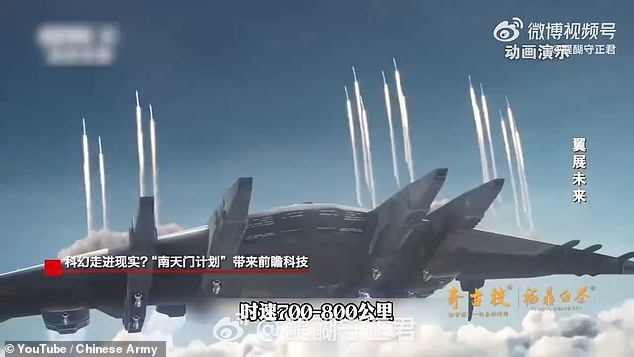

Military technology is increasingly borrowing ideas from science fiction, and China’s latest concept feels like something lifted straight from a space opera.
The country has revealed plans for a massive airborne “space carrier” that could operate at the very edge of Earth’s atmosphere while unleashing waves of unmanned fighter jets below.
Meet the Luanniao, China’s Ambitious Space Warship
According to Chinese disclosures, the proposed craft—named Luanniao—would be unlike anything currently in existence.
Designers claim it could soar close to the boundary between Earth and space while functioning as a flying launch pad for combat drones.
If it ever becomes reality, it would be the largest warship of its kind in the world.
A Floating Giant With Staggering Dimensions
On paper, the Luanniao is colossal.
Plans describe a vessel stretching roughly 794 feet long and 2,244 feet wide, with a takeoff weight of around 120,000 tonnes.
Chinese officials suggest it could be airborne within 20 to 30 years, a timeline that already raises eyebrows among experts.
Nearly 100 Unmanned Fighter Jets on Board
The real headline feature is its payload.
The Luanniao is designed to carry up to 88 unmanned Xuan Nu fighter jets.
These aircraft are still conceptual but are envisioned as agile stealth drones capable of firing hypersonic missiles, making them extremely difficult to detect or intercept.
Why Military Analysts Are Paying Attention
If such a platform were ever completed, it could dramatically shift aerial warfare.




Defence expert Peter Layton, a visiting fellow at Australia’s Griffith Asia Institute, has said the Luanniao would “outclass pretty much everyone.”
Speaking to The Telegraph, he explained that flying at extreme altitudes would place the craft above most surface-to-air missiles, enemy aircraft, and even weather systems.
A Weapon That Could Hover Above Its Targets
Another proposed advantage is positioning.
Operating near the edge of space could allow the Luanniao to sit almost directly above a target, making strikes more precise and harder to defend against.
From that height, many existing defensive systems would simply be ineffective.
Part of China’s Broader Nantianmen Vision
The Luanniao isn’t a standalone idea. It falls under China’s wider Nantianmen Project, which translates to “South Heavenly Gate.”
Developed by the Aviation Industry Corporation of China, the initiative aims to dramatically expand the country’s air and space capabilities and push the boundaries of aerospace technology.
From Science Fiction to Serious Debate
The concept first surfaced about a decade ago, and many observers dismissed it outright as fantasy.
Even today, scepticism remains strong.
The technology needed to keep such a massive craft hovering at the edge of Earth’s atmosphere simply doesn’t exist yet, especially at that scale.
Huge Technical Barriers Still Stand in the Way
Beyond the lack of proven technology, the challenges are enormous.
The Luanniao would demand vast amounts of fuel and likely an entirely new propulsion system.
Placing it into full orbit could be an alternative, but that would expose it to dangerous space debris.
Launching something this large would also require reusable rockets, an area where China is still working toward reliable success.
A Strategic Message More Than a Real Machine?
Given all these hurdles, some experts believe the project is more symbolic than practical.
Layton suggests the plans may be designed to boost China’s image both domestically and internationally.
For audiences abroad, he argues, it sends a powerful message that China is pursuing technology others can’t even realistically aim for—“literal Star Wars stuff.”
What Comes Next for the Luanniao Concept?
For now, the Luanniao remains firmly in the realm of ambitious design rather than deployable hardware.
Whether it ever leaves the drawing board or simply serves as a statement of intent, one thing is clear: China wants the world to know it’s thinking far beyond conventional battlefields—and straight toward the edge of space.
