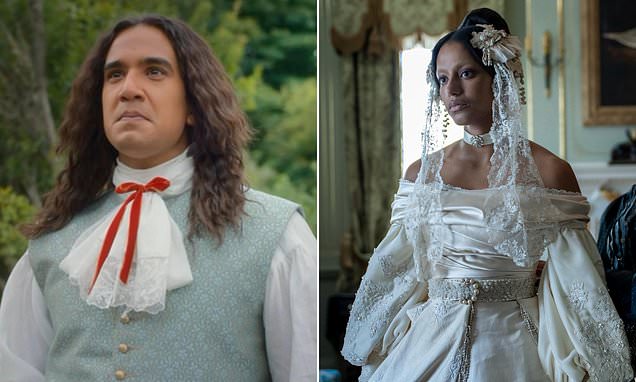
The BBC is facing fresh scrutiny over its casting decisions, especially when it comes to ethnic minority actors in historical dramas.
A recent independent report has highlighted what some are calling “clunky” or tokenistic choices, such as the casting of mixed-race actors in period dramas where historical accuracy might clash with modern diversity goals.
For instance, Nathaniel Curtis, a mixed-race actor, was cast as Sir Isaac Newton in a milestone 60th anniversary episode of Doctor Who.
Similarly, Shalom Brune-Franklin played Estella in a 2023 adaptation of Great Expectations, set in the early to mid-19th century.
Critics argue that while science-fiction shows like Doctor Who allow some creative flexibility, historical dramas risk appearing forced if diversity is added without careful context.
Striking a Balance Between History and Representation
The report acknowledges the tricky line the BBC must walk.
On one hand, “colour-blind casting” opens up more roles for actors of colour, who otherwise face limited opportunities in period pieces.
On the other hand, placing ethnic minority actors in historical settings where such representation would have been unlikely may unintentionally erase the past struggles of those communities.
Murder mysteries like the BBC’s 2023 adaptation of Murder Is Easy were cited, where modern diversity choices might clash with audience expectations for historical accuracy.
As the report notes, viewers of traditional Agatha Christie dramas might find it jarring if narratives suddenly delve into anti-colonial themes or other historically sensitive issues.
Challenges Beyond Ethnic Diversity
Diversity issues at the BBC aren’t limited to ethnicity.




The report criticizes how working-class communities are portrayed, particularly white working-class men and women.
It points out that stories often focus on poverty, crime, addiction, and industrial decline, with few positive role models.
Shows like Denmark, set in Blaenau Gwent, Wales, were highlighted for depicting local characters as trapped by their circumstances, reinforcing negative stereotypes.
Additionally, older women remain underrepresented on-screen, particularly in news and factual programming.
Male presenters dominate older age brackets, while women struggle for equal visibility and career longevity within the BBC.
London-Centric Production Concerns
The report also calls out the BBC’s heavy reliance on London for commissioning, news, and production.
Programs created in Scotland, Wales, and Northern Ireland often struggle to gain national attention, despite strong regional interest.
For example, The Ice Cream Wars, commissioned by BBC Scotland, initially went unseen nationally but later found success on BBC Two, Netflix, and BBC Select.
News programming has faced similar criticism.
Newsnight, after its 2024 studio-only revamp, now relies heavily on London-based coverage, reducing on-the-ground reporting across the UK and reinforcing perceptions of the BBC as middle-class and London-centric.
Recommendations for Change
The report suggests that the BBC place more decision-makers outside London and focus on producing content rooted authentically in local contexts.
It recommends new diversity metrics that measure class, geography, and gender representation alongside ethnicity.
The review also stresses that audiences want representation that feels genuine, not performative.
By integrating regional perspectives and broadening opportunities for all actors and presenters, the BBC can better reflect the full spectrum of life across the UK.
BBC’s Response
BBC chairman Samir Shah welcomed the report, emphasizing the need for authenticity in representing all communities and classes across the UK.
The BBC Executive committed to strengthening how it measures portrayal and representation in its content and highlighted ongoing improvements, including increased regional investment and more diverse voices both on-screen and behind the camera.
The corporation acknowledges there’s still work to do, particularly in balancing historical authenticity with inclusion, expanding gender representation, and decentralizing decision-making from London to better serve audiences across the country.
Share on Facebook «||» Share on Twitter «||» Share on Reddit «||» Share on LinkedIn