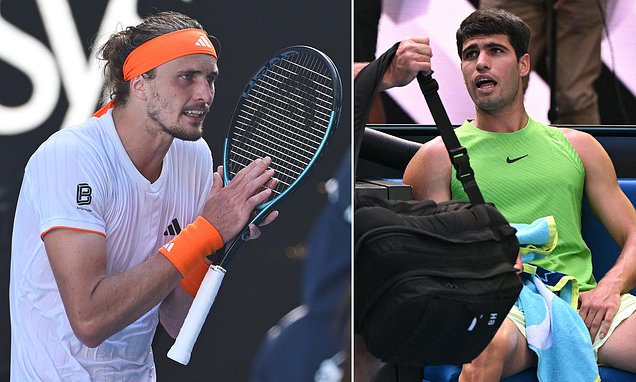
Tensions boiled over at the Australian Open as Alexander Zverev exploded in frustration during his marathon semi-final against Carlos Alcaraz.
What started as a high-stakes clash between two of the world’s top players quickly turned chaotic when Zverev accused Alcaraz and Jannik Sinner of receiving special treatment from tournament officials.
The German star’s anger came to a head during the third set of the grueling five-hour battle, after he had fought back from a two-set deficit and was serving for the match.
Alcaraz, meanwhile, appeared physically drained but managed to mount an astonishing comeback, eventually snatching victory late in the fifth set.
The Controversial Medical Timeout
Zverev’s fury centered on a medical timeout Alcaraz took mid-match.
After losing a point at 4-4 in the second set, the Spaniard paused to stretch his groin, prompting the chair umpire, Marijana Veljovic, not to call a time violation.
To Zverev, it seemed like unnecessary gamesmanship.
At the end of that game, Alcaraz called the physio to receive treatment, which Zverev argued was against the rules since cramping isn’t officially supposed to justify a medical timeout.
“He has cramp! He can’t take a medical, he is cramping. What else should it be?”
Zverev yelled in a mix of English and German. “This is absolute bulls***. This is unbelievable. You cannot be serious.”
The German repeatedly slammed the decision, insisting Alcaraz was being given special leeway because of his status in men’s tennis.




“You are protecting both of them,” he fumed, referring to Alcaraz and Sinner.
The Debate Over Cramp and Fair Play
Cramping in tennis is officially a gray area.
While it’s not supposed to qualify for medical treatment, players sometimes walk a fine line between cramp and more serious injury.
Some analysts, like former coach Miles Maclagan, argued that Zverev had a point.
“From Zverev’s perspective, he sees it as cramp and wants to keep the pace,” Maclagan told TNT Sports.
“Many feel that if a player takes a medical timeout, there should be some penalty, because Zverev’s fitness is one of his major strengths, and it was somewhat negated here.”
The controversy isn’t new.
Other players, such as Daniil Medvedev, have faced scrutiny for similar situations, with officials initially penalizing him before rescinding the violation upon review.
Alcaraz Fights Back Despite Physical Strain
Alcaraz wasn’t just dealing with cramp; he admitted earlier in the match that he had vomited and struggled to take in fluids.
After receiving treatment and taking quick sips of pickle juice, he returned to the court, eventually dropping the third and fourth sets but clawing back to win in a thrilling fifth.
The final scoreline read 6-4, 7-6 (7-5), 6-7 (3-7), 6-7 (4-7), 7-5, marking the longest semi-final in Australian Open history.
Despite fatigue and injury concerns, the 22-year-old Spaniard showed incredible resilience.
“I always say that you have to believe in yourself, no matter your struggles,” Alcaraz said after the match, visibly exhausted but elated.
“Physically, it was one of the most demanding matches I’ve ever played. I had to put my heart into the match until the last ball.”
Looking Ahead to the Final
With this win, Alcaraz advances to his first-ever Australian Open final and the chance to compete for a career Grand Slam, having already claimed titles in Paris, London, and New York.
He expressed gratitude to the crowd for their support and joked about the pressure of chasing the title.
His physical toll was clear: his brother Alvaro had to carry his bags off the court.
Now, Alcaraz will rest and wait to see whether Jannik Sinner or Novak Djokovic will join him in Sunday’s final showdown.
Share on Facebook «||» Share on Twitter «||» Share on Reddit «||» Share on LinkedIn