Stablecoin issuer Circle Internet Group is setting its sights on building a sturdier foundation for digital finance this year.
The company wants to make it easier for businesses and institutions to adopt and use its products, signaling a shift from experimentation to serious production-ready solutions.
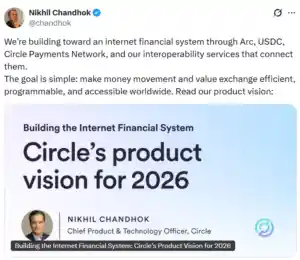
Nikhil Chandhok, Circle’s chief product and technology officer, shared in a blog post on Thursday that the firm plans to move Arc—its layer-1 blockchain tailored for large-scale institutional use—from the testnet stage into full production over the coming months.
Expanding the Reach of Circle’s Tokens
Alongside its blockchain push, Circle is focusing on increasing the utility of its stablecoins.
This includes USDC, EURC, USYC, and several partner-launched tokens.
The goal, Chandhok said, is to make these assets more accessible across multiple networks, while tightening their integration with Arc.




“This means making it easier for institutional users to hold, transfer, and program with these tokens as part of their day-to-day operations,” Chandhok wrote.
Essentially, Circle wants businesses to spend less time worrying about infrastructure and more time actually using stablecoins in meaningful ways.
Stablecoins Take Center Stage
Stablecoins became a major talking point in 2025 after the US passed regulations targeting these assets, prompting banks and institutions to explore launching their own tokens.
The sector is now booming, with USDC alone holding the second-largest share of the US dollar-pegged stablecoin market at over $70 billion, trailing only USDT’s $186 billion.
The stablecoin market overall surpassed $300 billion in market capitalization for the first time in October 2025, led primarily by USDT, USDC, and Ethena Labs’ yield-bearing stablecoin, USDe.
Building Infrastructure for Institutional Adoption
Circle is also prioritizing scaling its applications, such as its payments network, so that institutions can adopt stablecoin-based payments without having to build the backend themselves.
This includes streamlining “chain complexities” and improving developer tools to make cross-chain functionality smoother and more intuitive.
Chandhok emphasized that the company is looking to expand its ecosystem of partners and developers, aiming to increase global reach and practical use cases for stablecoins.
The focus is on turning these digital assets into everyday tools for finance at an internet scale.
What’s Next for Circle and USDC
As the crypto world watches, Circle’s 2026 roadmap is all about bridging the gap between experimentation and mainstream institutional use.
Between production-ready blockchains, cross-chain token expansion, and user-friendly infrastructure, the firm is positioning itself to make stablecoins a core part of the financial landscape—without the headaches that come with building all the underlying technology from scratch.F
Share on Facebook «||» Share on Twitter «||» Share on Reddit «||» Share on LinkedIn