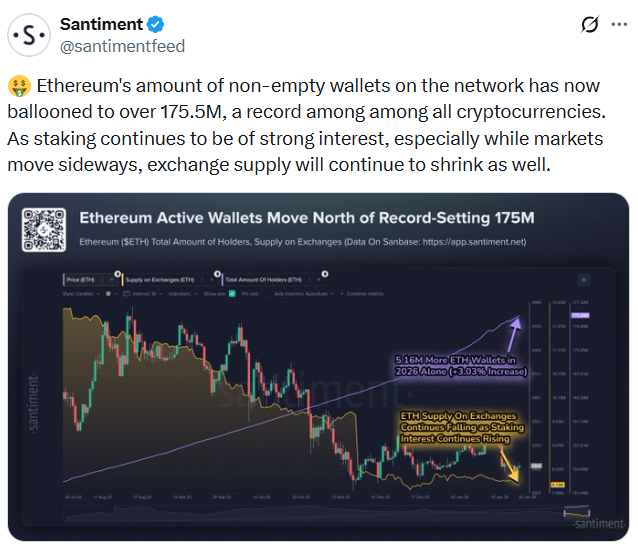
Over the past six months, Ether (ETH) has been slowly disappearing from crypto exchanges, even as its price has remained fairly steady.
According to blockchain analytics firm Santiment, holders are increasingly putting their tokens into staking rather than keeping them available for trading.
Exchange Supply Drops Significantly
Santiment shared data from Sanbase showing that the total Ether held on exchanges peaked at 12.31 million tokens in July.
Since then, that number has steadily fallen to just 8.15 million.
The trend suggests that traders and investors are choosing to lock up their ETH instead of keeping it liquid, especially during a period of muted price movements.
Ether has been drifting between $2,801 and $3,034 over the past week, according to CoinGecko.
Santiment notes that when prices remain stable, staking becomes more attractive to holders.
“As staking continues to be of strong interest, especially while markets move sideways, exchange supply will continue to shrink as well,” they said.
Staking Wait Times Climb
Ethereum Validator Queue reports that as of Thursday, around 3.6 million ETH are lined up to be staked, with a projected 63-day wait before entry.
By contrast, only 44,448 tokens are waiting to exit staking, with a much shorter estimated wait of 18 hours.



The network enforces limits on how many validators can enter or leave staking per epoch to protect its stability.
Currently, more than 36 million ETH are staked — roughly 29% of the total supply — a slight drop from 35 million in June, according to beaconcha.in and Dune Analytics.
Ethereum operates on a proof-of-stake model, meaning validators must lock up ETH to secure the network.
Staking is often interpreted as a vote of confidence in the asset, whereas unstaking can indicate that holders are preparing to sell.
Bitmine Doubles Down on Staking
Institutional players are also increasing their staking activity.
Tom Lee’s Ether treasury firm Bitmine recently added 250,912 ETH to its staking pool, bringing its total to over 2.5 million tokens.
This represents roughly 61% of the company’s total holdings, according to analytics firm Lookonchain.
Bitmine initially began staking in December, transferring 74,880 ETH to the network.
The company’s growing commitment illustrates a broader trend of large holders locking up ETH rather than keeping it available for trading.
Stakers Are Accumulating More Tokens
Retail and institutional stakers appear to be buying additional Ether as well.
Lookonchain reported that four staking wallets withdrew more than 26,000 ETH from Binance on Tuesday, suggesting they might be accumulating more tokens for future staking opportunities.
Trading volume for Ether on CoinMarketCap fell to around $23.54 billion on Thursday, down from more than $27 billion the day before.
This lower liquidity aligns with the ongoing movement of ETH off exchanges.
Staking Trends Suggest Confidence in Ether
Overall, the decline of ETH on exchanges combined with the rise in staking activity signals that holders are increasingly willing to lock up their tokens for longer periods.
While prices remain steady, staking continues to grow, and large holders like Bitmine are setting the tone for the market.
The Ethereum staking story highlights how investor behavior is shifting in a sideways market, reflecting both confidence in the network and the appeal of yield through staking.
Share on Facebook «||» Share on Twitter «||» Share on Reddit «||» Share on LinkedIn