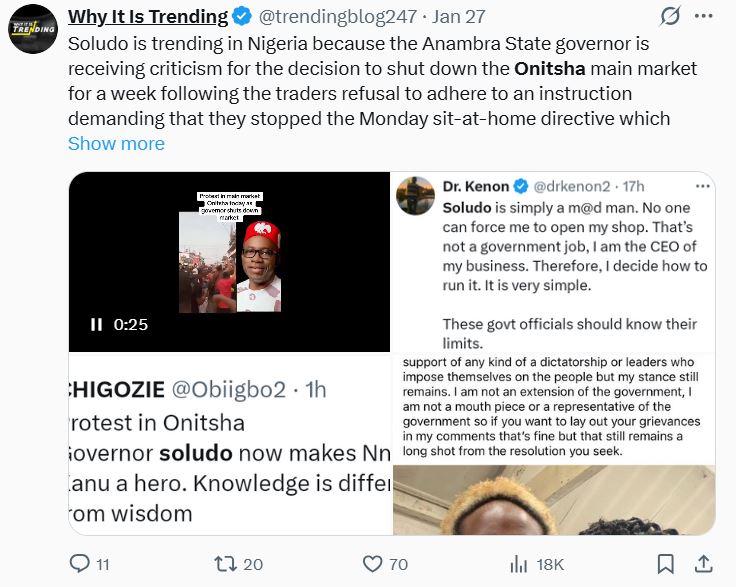
ONITSHA, Nigeria — The commercial nerve center of Onitsha is currently gripped by tension as hundreds of aggrieved traders have taken to the streets to protest Governor Chukwuma Soludo’s decision to shut down the Onitsha Main Market.
The demonstration, which reached a fever pitch on Wednesday and Thursday, saw protesters blocking the strategic Niger Bridge, effectively cutting off the primary gateway between the South-East and South-South regions of Nigeria.
The Catalyst: A “Punitive” Shutdown
The crisis began on Monday, January 26, 2026, when Governor Soludo paid an unscheduled visit to the market. Upon finding the shops closed—a lingering observance of the “Monday sit-at-home” directive originally initiated by the Indigenous People of Biafra (IPOB)—the Governor ordered the immediate closure of the market for one week.
Soludo characterized the traders’ failure to open as “economic sabotage,” warning that the closure could be extended to a month if the defiance continues. “Anambra is open to everybody, but if you must trade here, you must abide by the rules,” the Governor stated during his inspection.
Escalation: 12 More Markets Affected
In a move that has further polarized the state, the Anambra government announced today, January 29, the expansion of the “no-work-no-trade” policy.
Twelve additional markets, including Ochanja Central, Bridgehead, and Ogbaru Main Market, have been warned of a one-month total closure if they continue to observe the Monday sit-at-home.




Traders’ Grievances: “Security, Not Punishment”
Protesting traders at the Niger Bridge Head expressed a sense of betrayal. Chanting “No way in, no way out,” they argued that their compliance with sit-at-home is born out of fear for their lives rather than support for agitators.
“We expected the Governor to give us security when hoodlums were attacking us on Mondays, but they were not there,” one trader told reporters. “Now, the same police and army they couldn’t provide for our safety are being used to barricade our shops.”
The gridlock at the bridge has left thousands of travelers stranded for hours, with many calling on the Federal Government to intervene before the situation degenerates into a total breakdown of law and order.
Political and International Backlash
The Governor’s hardline approach has drawn sharp criticism from various quarters:
-
Legislative Pushback: Obi Aguocha, a member of the House of Representatives, faulted the move, warning it could “reignite violence” in the South-East. He argued that the Governor cannot legally compel private citizens to trade.
-
Ohanaeze Ndigbo: While the apex Igbo socio-cultural group backed the Governor’s intent to end the sit-at-home, they urged him to summon market leaders for dialogue rather than resorting to mass economic punishment.
-
International Pressure: Two U.S.-based organizations, the Rising Sun Foundation and the Global Coalition for Biafra Restoration, have threatened to lobby Western nations to declare Governor Soludo persona non grata, accusing him of “economic suffocation” of his own people.
What’s Next?
As of Thursday morning, Governor Soludo has convened a “crucial meeting” with market leaders from across the state at the International Conference Centre in Awka.
The outcome of this meeting is expected to determine whether the government will soften its stance or if the siege on the South-East’s economic heart will continue.
Anambra State Police Command, led by CP Ikioye Orutugu, remains on high alert, with joint security teams patrolling major junctions in Onitsha to prevent further blockades.
TDPel Media Newsroom Reporting on the frontlines of Nigeria’s breaking news and economic updates.
Share on Facebook «||» Share on Twitter «||» Share on Reddit «||» Share on LinkedIn