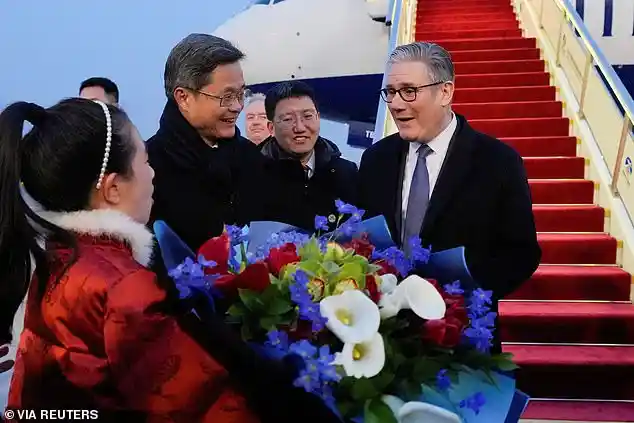
British Prime Minister Keir Starmer is preparing for a high-stakes diplomatic trip to Beijing, marking the first visit by a UK leader to China in eight years.
While the trip has been billed as a chance to revive economic ties, critics have questioned whether Starmer is being too trusting in dealing with President Xi Jinping, citing human rights abuses and national security concerns.
Balancing Trade Ambitions with Human Rights Concerns
Starmer has defended his decision to engage directly with China, arguing that the UK cannot ignore the world’s second-largest economy.
Speaking to British business leaders traveling with him, he described the visit as “historic” and emphasized the potential for economic growth.
China, along with Hong Kong, is the UK’s third-largest trading partner, and Starmer said opportunities exist across multiple sectors.
Yet opposition voices warn that these opportunities come at a cost.
Kemi Badenoch, a senior Conservative MP, suggested that Starmer should focus instead on strengthening ties with allies who share concerns about China’s global behavior.
Meanwhile, former security officials have raised alarms about espionage risks, noting that Starmer and his team have been issued disposable phones and laptops for the trip.
Security Measures Reflect Lingering Spy Concerns
The trip has sparked a wave of security precautions.
Intelligence reports indicate that state-sponsored Chinese hackers previously targeted the communications of UK officials, including aides to former Prime Ministers Boris Johnson, Liz Truss, and Rishi Sunak.



Starmer is traveling on a chartered commercial plane, and officials are taking unusual measures, such as setting up tents in hotel rooms to prevent surveillance while changing.
Despite the drama, Starmer has assured reporters that “robust schemes” are in place to protect sensitive communications.
Diplomatic Tightrope: Trade Talks and Human Rights
Starmer’s discussions with President Xi are expected to focus heavily on trade, particularly easing access for British firms in China.
At the same time, he faces pressure to confront Xi on serious human rights issues, including the detention of Hong Kong democracy campaigner Jimmy Lai and the broader treatment of Uyghur Muslims in Xinjiang.
While Starmer previously backed a Commons motion recognizing atrocities in Xinjiang, he stopped short of calling China’s actions “genocide” during this trip.
Calls for a Moral Stand Amid Diplomatic Outreach
Critics argue that Starmer risks appearing conciliatory at the expense of moral principles.
Sebastian Lai, the son of Jimmy Lai, urged the Prime Minister to prioritize securing his father’s release from prison, questioning the optics of building a “mega embassy” in London while a 78-year-old political prisoner remains behind bars.
Daisy Cooper, the Lib Dem deputy leader, called the visit a mistake, warning that seeking trade deals while pro-democracy activists are under threat sends the wrong message.
Divergent Views Within UK Politics
Even within Starmer’s own country, voices are divided.
Deputy Prime Minister David Lammy defended engagement, describing it as a necessary recognition of China’s global influence.
Conversely, Badenoch argued that the timing was wrong, suggesting the UK should prioritize dialogue with other nations facing economic and security pressures from Beijing.
Luke de Pulford of the Inter-Parliamentary Alliance on China echoed this skepticism, claiming the Chinese government has little interest in investing in the UK beyond critical infrastructure.
A Historic Visit Under the Spotlight
Starmer’s journey to Beijing highlights the difficult balancing act facing world leaders: pursuing economic opportunities while managing ethical obligations and national security risks.
The Prime Minister’s talks with Xi will be closely watched, both for signs of strengthened trade ties and for any movement on pressing human rights concerns.
As the UK navigates this “historic” visit, Starmer must weigh diplomacy against principle in a relationship defined by both opportunity and tension.
Share on Facebook «||» Share on Twitter «||» Share on Reddit «||» Share on LinkedIn