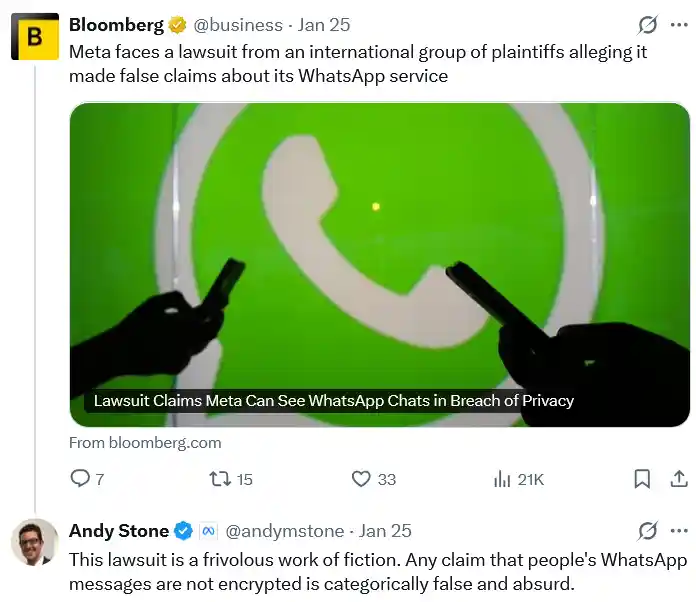
Meta is fighting back against a new lawsuit that claims its messaging app WhatsApp isn’t as secure as users believe.
On Monday, Andy Stone, Meta’s communications director, took to X to call the lawsuit “a frivolous work of fiction” and strongly denied any suggestion that WhatsApp can read users’ private messages.
According to Stone, the app’s end-to-end encryption works exactly as advertised.
Lawsuit Alleges End-to-End Encryption Is a Sham
The legal action, filed Friday in a U.S. district court in San Francisco, was brought by WhatsApp users from Australia, Mexico, South Africa, and India.
The plaintiffs argue that Meta misleads users by claiming their messages are private while allegedly having the capability to access them.
They are seeking damages and hope the case will “expose the fundamental privacy violations and fraud” they claim Meta is committing.
Industry Rivals Join the Conversation
Telegram CEO Pavel Durov weighed in on the lawsuit, lending support to the plaintiffs.




Durov tweeted that anyone trusting WhatsApp’s security in 2026 is being naive, adding that his team had identified several potential attack vectors in WhatsApp’s implementation of encryption.
Meanwhile, Meta has yet to release a formal public statement, but its end-to-end encryption explainer reassures users that only the sender and recipient can read messages.
Privacy Concerns Drive Users Toward Alternatives
This lawsuit comes amid growing concerns over centralized messaging platforms and user privacy.
As trust in traditional apps is questioned, many are turning to decentralized, encrypted options that give users more control over their communications.
Decentralized Apps Gain Popularity in Crisis Zones
One app seeing a surge in adoption is Bitchat, launched by Jack Dorsey.
Bitchat uses Bluetooth mesh networks to allow private messaging without an internet connection, making it particularly useful in countries facing social media restrictions or during natural disasters.
Downloads have increased in places like Uganda, Iran, Nepal, Indonesia, and Jamaica.
Other privacy-focused alternatives include Session and X-Messenger, which also offer end-to-end encryption.
The Privacy Debate Isn’t Going Away
As concerns over digital privacy intensify, users are increasingly weighing convenience against security.
Lawsuits like the one against Meta highlight the tension between corporate assurances of safety and the growing demand for transparent, verifiable protections for personal communication.
What Comes Next
The case will proceed in San Francisco’s federal courts, with Meta defending its claims of secure encryption.
Meanwhile, users and privacy advocates will be watching closely, as the outcome could influence the future of messaging platforms and digital privacy standards worldwide.
Share on Facebook «||» Share on Twitter «||» Share on Reddit «||» Share on LinkedIn