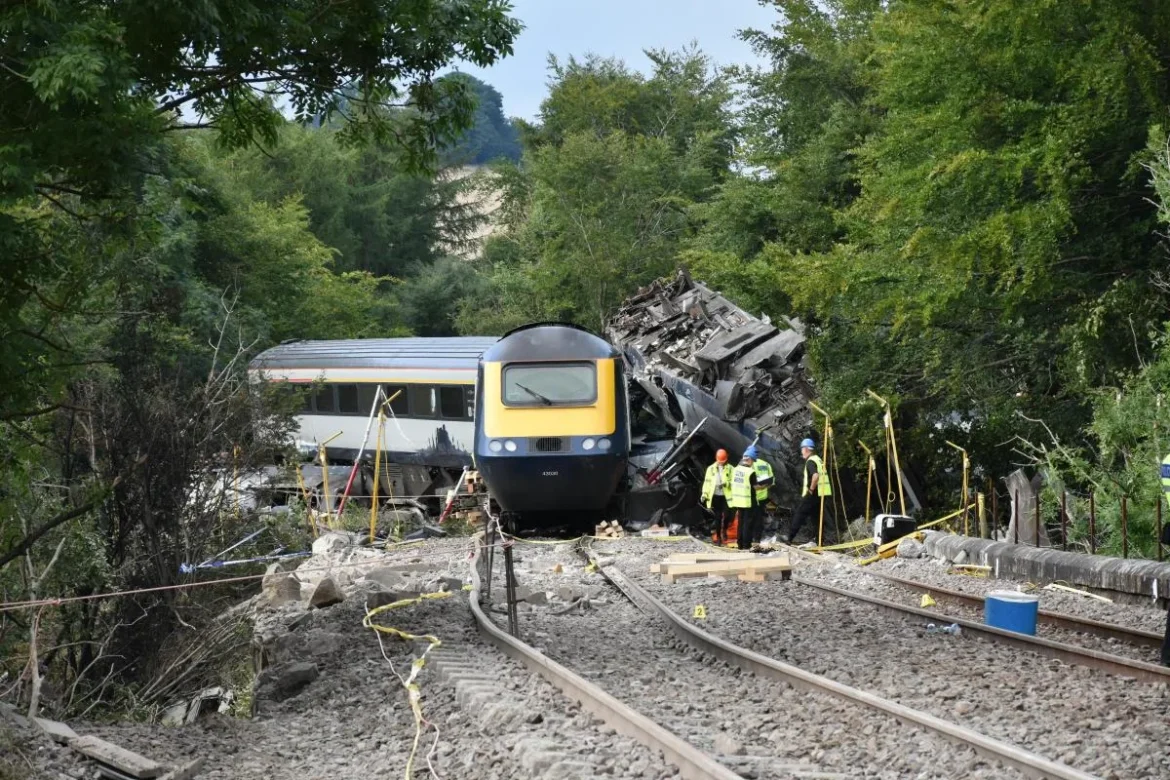
The quiet town of Stonehaven in Aberdeenshire was rocked by a devastating train accident on August 12, 2020.
Heavy rainfall had caused debris to wash onto the railway track near Carmont, leading to the derailment of a passenger train.
The incident claimed the lives of three people and left others seriously injured.
A fatal accident inquiry (FAI) opened at Aberdeen Sheriff Court on Monday, shedding light on the heartbreaking details of the crash.
Victims and Their Families
The inquiry confirmed that the three people who died suffered injuries that would have been impossible to survive.
They were train driver Brett McCullough, 45; conductor Donald Dinnie, 58; and passenger Christopher Stuchbury, 62.
During the derailment, Mr. Stuchbury was reportedly thrown clear of the train, while Mr. McCullough’s body was found near the lower embankment where the train carriages had scattered after striking a bridge parapet.
Mr. Dinnie’s body was trapped in the doorway of one of the coaches and could not be recovered until the following day.
Crown counsel Alex Prentice KC told the court that post-mortem examinations revealed all three had suffered multiple blunt force injuries.
He said the injuries were “non-survivable” and death would likely have been immediate.




Loved Ones Speak Out
The inquiry also heard statements from the victims’ families, sharing their grief and heartbreak.
Diane Stuchbury, wife of Christopher Stuchbury, expressed the profound loss she felt, noting that her husband died on their wedding anniversary.
Her statement described him as “the most loving, kind, wise, and loyal man you could ever wish to meet” and lamented that their future together had been stolen by the tragedy.
Mr. Dinnie’s family also shared their sorrow, describing him as “loved and adored by all his family and friends” and saying he would “be forever missed.”
Emergency Response Challenges
Emergency crews arriving at the crash site faced a “highly complex incident,” the inquiry heard.
Two firefighters were injured while assisting at the scene.
Inspector of rail accidents Nick Bucknall explained that the train had collided with debris washed from a drain onto the track following unusually heavy rainfall around 9:37 a.m.
The train was travelling at 73 mph at the time of the crash.
Bucknall noted that the drainage system in the area was unable to handle the surface water, and gravel in the drainage trench was particularly vulnerable to washout.
Network Rail did not have extra safety measures in place, and the train’s speed was not restricted at the time.
Investigation Findings and Accountability
A Rail Accident Investigation Branch (RAIB) report published in March 2022 found flaws in the construction of the drainage system installed by Carillion, which had gone into compulsory liquidation in January 2018.
These errors meant the system could not cope with the heavy rainfall on the morning of the crash.
The RAIB made 20 safety recommendations, many aimed at Network Rail, to prevent similar tragedies.
In a criminal prosecution in 2023, Network Rail was fined £6.7 million after admitting health and safety failings linked to the derailment.
Ongoing Inquiry
The fatal accident inquiry is scheduled to continue until February 13, resuming for a final week on February 23.
It aims to fully examine the circumstances that led to this tragic event, giving families, investigators, and officials a chance to uncover lessons and ensure rail safety improvements for the future.
Share on Facebook «||» Share on Twitter «||» Share on Reddit «||» Share on LinkedIn