Flying home from Davos aboard Air Force One, Donald Trump had a blunt message for Tehran: the United States is paying close attention.
Just days after violent protests rocked Iran and sparked global speculation about possible U.S. retaliation, the former president made it clear he wasn’t looking away.
“We’re watching Iran,” Trump said flatly, framing the moment as tense but not yet irreversible.
Warships on the Move, Options on the Table
Trump revealed that American military assets are already shifting position, hinting at a sizable naval presence moving closer to the region.
He described it as a “big flotilla” heading in Iran’s direction, stopping short of calling it an imminent strike force but leaving little doubt about its purpose.
While he stressed that he hoped nothing would come of it, he repeated that the U.S. was prepared if circumstances changed.
Jets, Carriers, and a Growing Military Footprint
Behind the rhetoric is a very real military buildup. U.S. F-15 Strike Eagles have recently touched down in Jordan, while the USS Abraham Lincoln Carrier Strike Group is making its way from the South China Sea toward the Persian Gulf.
The fleet includes destroyers, F-35 stealth fighters, and advanced electronic-warfare aircraft, underscoring Washington’s readiness to respond quickly if ordered.
A Threat — and a Hesitation
Trump acknowledged that the presence of what he called a “massive armada” could lead to direct action against Tehran.
Still, he struck a careful balance, suggesting force was a last resort.
“Maybe we won’t have to use it,” he said, adding only, “We’ll see.”
The ambiguity appeared intentional, keeping pressure on Iran without committing publicly to the next move.
Claiming Credit for Lives Spared
In a striking claim, Trump said he personally intervened to stop hundreds of executions tied to Iran’s recent unrest.
According to him, 837 protesters were spared from hanging after his warning to Iranian leaders.
He painted Iran’s methods as archaic, calling them relics of another era, even as he acknowledged the country’s deep and ancient cultural roots.
A Stark Ultimatum to Tehran
Trump recounted issuing a clear threat: if Iran went ahead with the executions, the response would be overwhelming.




He said he warned Iranian officials that retaliation would dwarf past actions, even comparing it to the U.S. withdrawal from the Iran nuclear deal — which he dismissed as minor by comparison.
The message, he suggested, was enough to make Tehran pause.
Are These Moves a Prelude to War?
Asked earlier by CNBC whether the repositioning of U.S. forces signaled something bigger, Trump remained evasive.
He said Washington hoped to avoid escalation but pointed to reports of protesters being shot in the streets as justification for concern.
The implication was clear: restraint has limits.
Boasting About American Firepower
The conversation soon turned to U.S. military strength.
Trump revisited a strike on Iran’s Fordow nuclear facility, praising the performance of B-2 stealth bombers.
He described the aircraft as virtually invisible, striking in total darkness with pinpoint accuracy.
Every bomb, he claimed, hit its mark.
He also noted that the U.S. has ordered 25 more of the bombers, reinforcing long-term capabilities.
Damage Done, but Not Total Destruction
Early intelligence assessments suggest the strikes significantly disrupted Iran’s nuclear program but didn’t erase it entirely.
Instead, analysts believe the damage pushed Tehran’s progress back by several months, buying time rather than delivering a permanent solution.
Clashing With Critics at Home
When CNBC’s Joe Kernen remarked that Democrats had fiercely criticized Trump over Iran, Trump didn’t hold back.
He dismissed his opponents as irrational, reviving his familiar refrain about “Trump derangement syndrome.”
Even decisive military action, he implied, would never satisfy his critics.
A Red Line Drawn Around Nuclear Ambitions
As the discussion wrapped up, Trump urged the world to “stay tuned,” signaling that the story is far from over.
He was explicit about his bottom line: Iran’s nuclear experimentation.
If Tehran continues down that path, he warned, the U.S. response would come again.
Tehran Fires Back With Its Own Warning
Iran’s leadership did not let Trump’s remarks go unanswered.
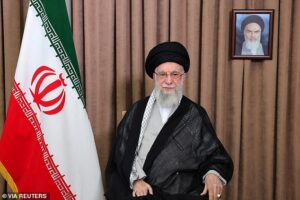
After he publicly called for the Supreme Leader to step aside, General Abolfazl Shekarchi issued a sharp rebuttal.
Any aggression toward Ayatollah Ali Khamenei, he said, would be met with devastating consequences.
In stark terms, Shekarchi warned that Iran would not only retaliate but ignite a wider conflict if its leader were threatened.
What Comes Next?
With military forces repositioning, rhetoric escalating, and both sides drawing clear lines, the standoff shows no signs of cooling.
For now, the world is left watching — just as Trump says he is — waiting to see whether the warnings remain words or turn into action.
Share on Facebook «||» Share on Twitter «||» Share on Reddit «||» Share on LinkedIn