The team that has long built and maintained Zcash just made a dramatic move.
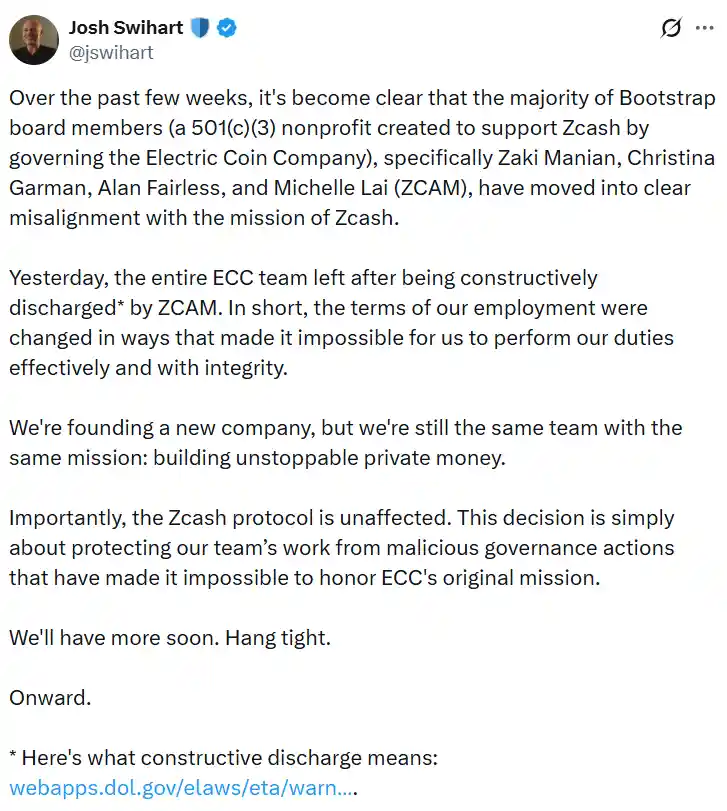
Every member of the Electric Coin Company (ECC), the group most closely associated with developing the privacy-focused cryptocurrency, has stepped away from Bootstrap — the nonprofit set up to support Zcash.
According to ECC CEO Josh Swihart, the team is now preparing to launch an entirely new company.
The break didn’t come out of nowhere.
Swihart says tensions had been building for weeks before things finally reached a breaking point.
Why the Relationship Fell Apart
In a statement shared on Wednesday, Swihart said that several members of the Bootstrap board — naming Zaki Manian, Christina Garman, Alan Fairless, and Michelle Lai of ZCAM — had drifted away from what ECC believes Zcash was always meant to stand for.
According to him, recent governance decisions changed the nature of ECC’s employment in ways that made it impossible for the team to do their jobs “effectively and with integrity.”
Rather than compromise on principles, the team chose to walk.
“This wasn’t about drama or power,” Swihart explained.
“It was about protecting our work and our mission from governance actions we believe are harmful.”
Same Team, New Company, Same Mission
Even though ECC is leaving Bootstrap behind, Swihart emphasized that the heart of the project hasn’t changed.
The developers are staying together and forming a new company, with the same goal they’ve always had: building private, censorship-resistant digital money.
In his words, it’s still the same people, still focused on the same vision — just under a different organizational roof.




Zcash Keeps Running Without a Hitch
Despite the upheaval, Swihart was clear on one point: Zcash itself isn’t going anywhere.
The protocol continues to run as normal. Because Zcash is open-source and permissionless, no single group controls it.
Anyone can run a node, propose changes, or fork the code.
As long as miners, validators, and users stay active, the network remains alive and functional.
In other words, the software doesn’t depend on ECC — or any organization — to keep moving forward.
A Former CEO Pushes Back
Not everyone agrees with Swihart’s assessment of the situation.
Zooko Wilcox, ECC’s former CEO who handed leadership to Swihart in 2023, publicly defended the Bootstrap board.
In a post on X, Wilcox said he has worked closely with several of the board members for over a decade and described them as people of “exceptionally high integrity.”
He included Michelle Lai as well, noting years of collaboration.
Wilcox also echoed a key reassurance: regardless of internal disputes, the Zcash network remains secure, private, and fully operational.
For users, nothing has changed.
Market Reaction Tells Its Own Story
Traders, however, did react.
Zcash’s price slipped nearly 7% over the past 24 hours, hovering around $461 at the time of writing.
During that same window, it moved between roughly $452 and $497, according to CoinGecko data.
The drop comes after a strong run late last year.
In November, Zcash surged to about $723 amid a broader privacy-coin rally, helped along by public support from well-known industry voices like Arthur Hayes.
What Comes Next?
For now, Zcash continues on as it always has — decentralized, open-source, and independent of any single organization.
Meanwhile, the former ECC team is setting out on a new path, hoping to continue shaping the future of private digital money from a fresh starting point.
Whether this split strengthens or complicates Zcash’s long-term story remains to be seen.
What’s clear is that the debate around governance, privacy, and control in crypto is far from over.
Share on Facebook «||» Share on Twitter «||» Share on Reddit «||» Share on LinkedIn