What’s supposed to be a relaxing day by the ocean now comes with a serious health reminder, especially for people spending time along Florida’s coast.
State health officials are sounding the alarm again after confirming more cases linked to a dangerous flesh-eating bacteria that thrives in warm seawater.
Rising Concerns After New Infections Detected
Florida’s health department recently announced that two more people have been diagnosed with Vibrio vulnificus, a bacteria known for infecting cuts or wounds exposed to seawater.
This organism isn’t just another beach nuisance—it can lead to severe infections, sepsis, and even the loss of a limb.
The newly detected cases were recorded in Lee County, home to Fort Myers, and Nassau County, located near the Georgia border.
The state didn’t release details about whether the patients were hospitalized or what treatments they received, but the update places Florida’s total at 33 infections so far this year, alongside five deaths statewide.
A Look at the Bigger Picture Across the U.S.
Florida isn’t the only region keeping an eye on Vibrio.
Across the country, at least 72 cases in 12 states have been logged in 2025.
The majority of infections have occurred in the South, but even Massachusetts has reported a case—showing just how far the bacteria can reach when conditions are right.
Louisiana, in particular, is facing an extraordinary spike.
The state has documented 26 infections and five deaths, far higher than its usual annual average of seven to 10 cases.
Why This Bacteria Spreads So Easily
Vibrio thrives naturally in coastal waters, especially when temperatures rise from late spring through fall.
That’s why the period between May and October tends to see the most infections.
People are urged to watch for symptoms such as:
- Red or swollen skin
- Painful or rapidly worsening rashes
- Fluid-filled blisters
- Fever
- Confusion or altered mental state
Without quick medical attention, the infection can progress aggressively.
The CDC reports that one in five infected people die, and around 80 percent end up in the hospital.
Those with weakened immune systems, older adults, and individuals who eat raw seafood are particularly vulnerable.
Florida’s Reminder to Beachgoers
Health officials in Florida stress an important message: avoid getting into the water if you have open cuts or fresh wounds.
The advice appears in their latest notice, along with the warning that warm, brackish water is the natural habitat for Vibrio.
Interestingly, even with the latest cases, Florida’s numbers remain lower than last year’s totals—82 cases and 19 deaths in 2024, and 46 cases with 11 deaths in 2023.
National totals were also higher in 2024, with 82 infections and 19 deaths.
When Ordinary Outings Turn Dangerous
Some of the most striking cases this year show how easily the bacteria can enter the body.
A Swim That Turned Into a Medical Emergency
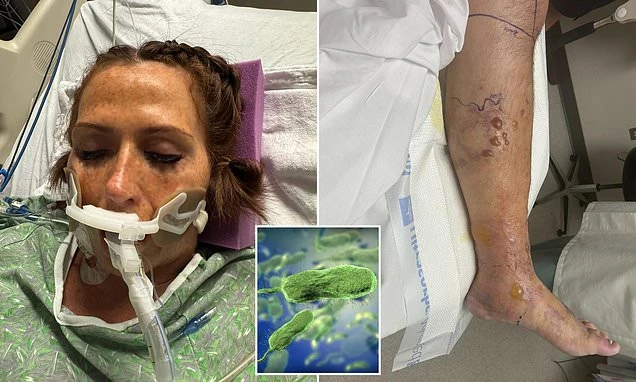
Earlier in the year, 49-year-old Genevieve Gallagher nearly died after swimming at Pensacola Beach with her daughter.
She felt fine afterward—until her leg ballooned with pain and blisters three days later.
Doctors diagnosed her with Vibrio and septic shock, warning that her organs were failing.
She described the pain as feeling like her leg was “set on fire,” adding that it looked nothing like her own by the time she reached the hospital.
Doctors ultimately had to remove most of the muscle in her left leg to save her.
A Fisherman’s Unexpected Infection
In another case, 88-year-old Albert Allison from Collier County got infected even though he never entered the water.
He was simply fishing from a dock. The next day, he noticed a bruise that quickly worsened.
He later learned he’d contracted Vibrio—possibly from handling a fish and accidentally scratching his leg without realizing it.
Fortunately, antibiotics were enough to treat his condition.
How Doctors Fight Vibrio Infections
Treatment depends on how early the infection is caught.
Physicians may use antibiotics, drain blister fluid, or provide IV fluids.
Severe cases sometimes require amputation to stop the bacteria from spreading through the body.
Share on Facebook «||» Share on Twitter «||» Share on Reddit «||» Share on LinkedIn